Jurassic Dinos editorial · Updated · Source-based review
What was Probrachylophosaurus?
Probrachylophosaurus bergei was a duck-billed dinosaur from Late Cretaceous North America. Its original description examined a large individual with skull and body material from the Judith River Formation of northcentral Montana. The animal belongs to the brachylophosaurin branch of the hadrosaur family tree.
What was unusual about its crest?
The describing study highlighted a relatively small, triangular nasal crest directed toward the back of the skull. Its form was intermediate between the crestless condition in Acristavus and the broad, flattened crest of adult Brachylophosaurus. Intermediate describes a comparison of features, not an animal that was somehow unfinished.
That distinction matters because the crest of Brachylophosaurus itself changes during growth. A smaller crest can resemble an earlier developmental stage of another species. Researchers therefore needed evidence beyond the outline alone to decide whether they were looking at a distinct taxon.
How did they test maturity?
The original study considered fusion between bones and microscopic structure in the tibia, a main lower-leg bone. Together these supported the conclusion that the Probrachylophosaurus individual was relatively more mature than a similarly large comparison specimen of Brachylophosaurus.
The authors consequently argued that its modest crest was not simply explained by immaturity. This illustrates a useful principle: similar size does not guarantee equal growth stage, and a young-looking feature does not make the entire animal a juvenile. Several lines of evidence are more informative than one visual impression.
Does transitional mean a proven direct ancestor?
The paper proposed that Probrachylophosaurus could represent an intermediate member of an evolutionary lineage. Its position in the rock sequence and its anatomy informed that hypothesis. They do not identify a particular individual as the documented parent of a later species or settle every detail of ancestry.
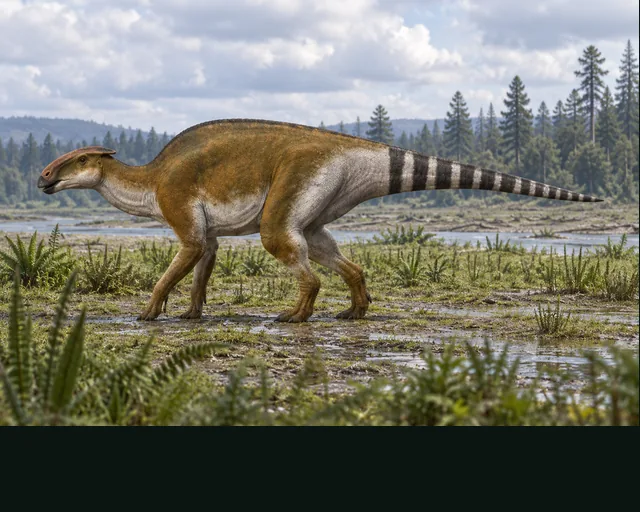
Our illustration follows a complete named living reconstruction with a broad beaked head, low skull profile, deep body and long tail. The coloured nasal patch, dorsal skin ridge and precise soft tissues are artistic, not preserved pigment evidence or an exact map of the bony crest. Compare Brachylophosaurus and Maiasaura, then explore the P directory for their separate scientific stories.
Quick answers
- Where was Probrachylophosaurus described?
- The Judith River Formation of northcentral Montana.
- What was distinctive about its crest?
- It was smaller and more triangular than the broad flat crest of adult Brachylophosaurus.
- Was it simply a young Brachylophosaurus?
- The original study used maturity evidence to argue against that interpretation.
- Does intermediate morphology prove direct ancestry?
- No. It supports an evolutionary hypothesis rather than identifying a documented parent.