Jurassic Dinos editorial · Updated · Source-based review
What was Probactrosaurus?
Probactrosaurus gobiensis was a plant-eating ornithopod from Early Cretaceous China. Its fossils were collected in the region now called Inner Mongolia. The animal is useful for exploring the evolutionary neighbourhood of the duck-billed dinosaurs without assuming that every nearby branch belonged to the same family.
Where did the material come from?
A 2002 revision explains that a joint Russian-Chinese expedition collected the fossils at Maortu, also written Maorty. Material assigned to P. gobiensis includes a substantial quantity of skeletal evidence, much of it kept in the Palaeontological Institute collections in Moscow.
A collection’s location today is different from the place where the animal lived. Museum specimens can travel for research, preparation or historical reasons. Keeping locality information attached to them allows researchers to reconstruct the discovery’s context rather than confusing a storage address with a fossil site.
What was interesting about its limbs?
The revision described the postcranial skeleton as gracile, meaning comparatively slender in build. It highlighted an elongated forearm and manus, the hand, together with a small conical pollex spine. Pollex refers to the first digit, comparable in position to a thumb.
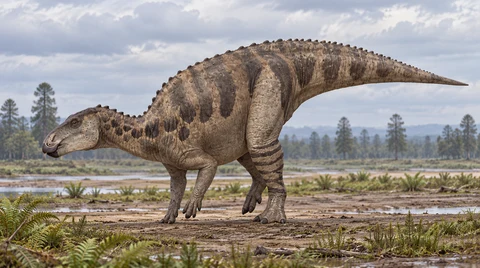
These details contribute to anatomical comparisons, but they should not become an invitation to add an enormous Iguanodon-style weapon to every illustration. Forearm and hand refer to different anatomical regions, so their proportions can be compared separately. The approved full-body reference supplies the external shape used here; the new image was not constructed from the fossil limb description.
Does the name identify an ancestor?
The name means before Bactrosaurus. That records a historical interpretation, not proof that the known species directly gave rise to Bactrosaurus. The 2002 analysis placed Probactrosaurus as a derived iguanodontian close to, but outside, Hadrosauridae. A sister-group relationship is a statement about branching, not a demonstrated parent-descendant sequence.
Family-tree hypotheses can be tested again with additional characters and specimens. Names generally remain usable even when those wider interpretations change. Our image shows a broad beaked head, deep trunk, shorter forelimbs, strong hindlegs and tapering tail, while colour and soft tissues remain artistic. Compare Bactrosaurus and Iguanodon, then browse the P directory for separately researched accounts and sources.
Quick answers
- Where did Probactrosaurus live?
- The region now known as Inner Mongolia in China.
- Was it a plant-eater?
- The museum identifies it as herbivorous.
- Does before Bactrosaurus prove direct ancestry?
- No. A name and an evolutionary hypothesis are different kinds of evidence.
- What does manus mean?
- The hand, including its constituent bones.