Jurassic Dinos editorial · Updated · Source-based review
What was Pradhania?
Pradhania gracilis was an early sauropodomorph from the Lower Jurassic of India. Sauropodomorphs include the evolutionary branch that later produced giant long-necked sauropods, but early members should not automatically receive the body proportions or locomotion of those later giants.
Its fossils came from the Upper Dharmaram Formation. The original description places this material in the Sinemurian, a stage of the Early Jurassic. A formation identifies a body of rock, while a geological stage identifies an interval of time; the two terms answer different questions about a discovery.
What makes its jaw informative?
Pradhania is known from fragmentary material. The describing paper highlights a prominent lengthwise ridge on the inner side of the maxilla, an upper-jaw bone. Features like this can contribute to distinguishing an animal even when much of its skeleton is missing.
Fragmentary does not mean scientifically useless, but it does limit the questions that can be answered confidently. A diagnostic jaw feature does not independently establish an exact adult weight, complete limb proportions or every detail of the living face. Those limits remain relevant even when a realistic illustration looks convincing.
Why must the other fossils in the paper stay separate?
The same study also discusses Lamplughsaura and another indeterminate sauropodomorph. Different specimens and taxonomic arguments belong to each of them. The multiple partial skeletons described for Lamplughsaura cannot simply be assigned to Pradhania to make its record seem more complete.
Likewise, a description of one animal as heavily built and quadrupedal is not automatically a description of every dinosaur in the article. Reading the specimen names carefully prevents a paper’s shared location or broad subject from erasing important differences among its animals.
Was it already a true giant sauropod?
The original analysis interpreted Pradhania as an early, stem sauropodomorph outside the more derived groups examined there. A stem position describes relationships, not an unfinished animal or a direct ancestor proven to lead to every later species.
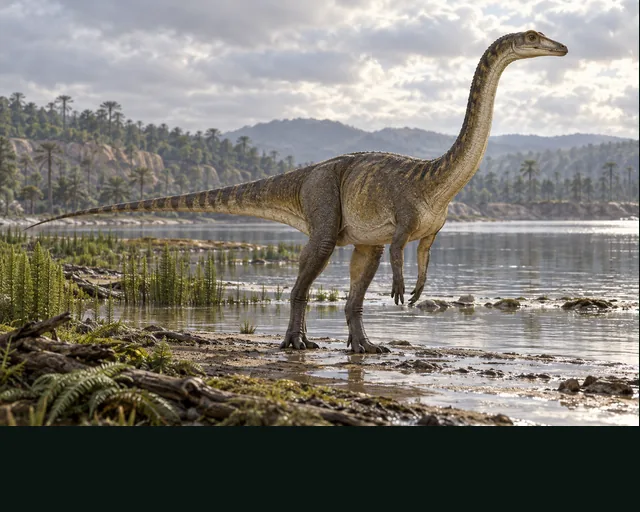
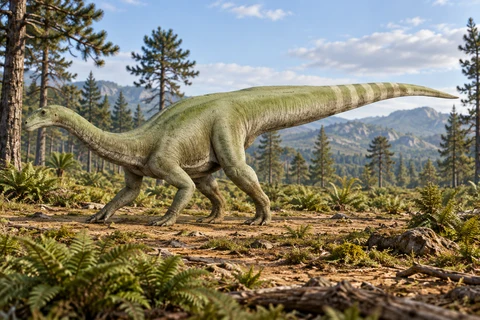
Our image follows the approved complete Pradhania artwork for its small head, long low neck, short forelimbs, bipedal hindlegs and tapering tail. It does not derive a body from the fragmentary fossils. Colours and missing proportions remain artistic. Compare Lamplughsaura and Massospondylus, then visit the P directory.
Quick answers
- Where did Pradhania live?
- The region now known as India.
- What kind of dinosaur was it?
- An early sauropodomorph rather than a fully derived giant sauropod.
- Was it the same animal as Lamplughsaura?
- No. The original paper describes them as distinct taxa with different material.
- What is a maxilla?
- An upper-jaw bone that carries teeth.