Jurassic Dinos editorial · Updated · Source-based review
What was Lamplughsaura?
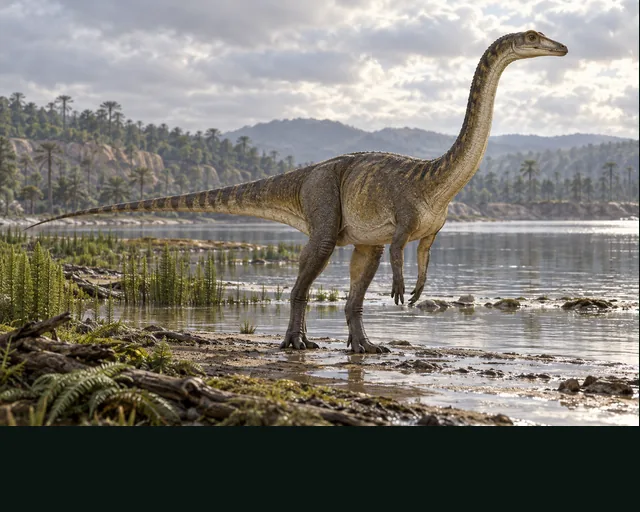
Lamplughsaura dharmaramensis was an early sauropodomorph dinosaur from the Lower Jurassic Upper Dharmaram Formation of India. Sauropodomorphs are the wider evolutionary group that includes the later giant sauropods and their earlier relatives. Lamplughsaura is interesting because its substantial, four-legged build sits near an important part of that evolutionary story.
What material was described?
The 2007 research reports several partial skeletons, rather than just a single loose tooth. The same study describes other Indian sauropodomorph material, including Pradhania. Their fossils need to be kept separate instead of combining every anatomical feature or size estimate from the paper into one animal.
The authors characterised Lamplughsaura as a heavily built quadruped. “Quadruped” means an animal supported on four limbs. That broad description is useful, but it does not tell us its precise walking speed, the angle of every joint during a normal step or how it held its neck throughout the day.
Why did its teeth and thumb claw matter?
The original abstract identifies distinctive tooth margins and features of the neck and tail vertebrae. The shape of the first manual claw also enters the comparison: “manual” refers to the hand, rather than the foot.
These are concrete anatomical questions. A long neck and four strong legs can suggest a broad group, but the finer comparisons help researchers test where an animal belongs within it. Similar body outlines do not make all early long-necked dinosaurs identical.
Was it definitely a true sauropod?
The authors’ preliminary analyses favoured a basal sauropod interpretation while also considering a position among more broadly defined stem sauropodomorphs. We retain that uncertainty rather than converting a preferred result into a permanent classification.
An evolutionary tree is a hypothesis built from compared features. “Near the base” of a branch does not mean that the named fossil was the direct ancestor of every later giant, nor does it describe an unfinished animal waiting to become something else.
Our image follows Nobu Tamura’s complete Lamplughsaura reconstruction. The bent-limb stance, subtle banding and woodland scene remain artistic interpretation. Compare Massospondylus and Barapasaurus as separately sourced relatives, then browse names beginning with L.
Quick answers
- Where was Lamplughsaura found?
- The Upper Dharmaram Formation of India.
- Was it known from one isolated tooth?
- No. The description reports several partial skeletons.
- Did the study infer four-legged support?
- Yes, it described a heavily built quadrupedal form.
- Is its exact family-tree position settled here?
- No. The original analyses considered alternatives.