Jurassic Dinos editorial · Updated · Source-based review
What was Perijasaurus?
Perijasaurus lapaz was an early eusauropod from northern Colombia. Eusauropods form a major branch of the long-necked sauropod dinosaurs. The describing study places it around the boundary between the Toarcian and Aalenian stages, near the transition from the Early to Middle Jurassic.
How much of it was discovered?
The defining specimen is a single trunk vertebra, catalogued as UCMP 37689. The University of Michigan fossil repository identifies it as an anterior-to-middle dorsal vertebra from the La Quinta Formation, west of Manaure. Dorsal refers to the trunk region rather than the neck or tail.
One informative bone can preserve a distinctive combination of anatomical features. It does not, however, provide a complete head, every limb or the animal’s living silhouette. The amount of material and the information it contains are separate questions: a small fossil record can be scientifically valuable without making the whole body certain.
Why did the locality need to be revisited?
The museum’s discovery account explains that the specimen was first found during geological mapping in 1943. Later work returned to the original site and improved study of the bone. That history shows why excavation dates and formal naming dates can be far apart.
The species name lapaz connects the discovery with peace accords that enabled access to the site. Field research depends on practical access, reliable records and opportunities to revisit localities, not only on recognising an unusual bone. Information about its rock layer helps place the fossil in the wider history of sauropod evolution.
What does it tell us about early sauropods?
The original study discusses a tropical lowland forest setting and vertebral features relevant to weight reduction in early sauropods. These comparisons contribute to questions about diversification at low latitudes. They should not be turned into an exact body mass or a claim that every detail of its physiology is known.
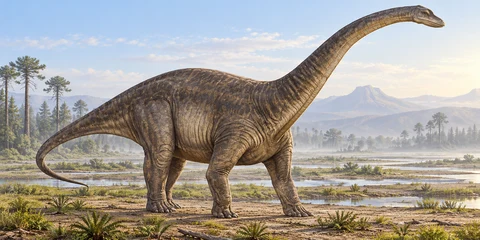
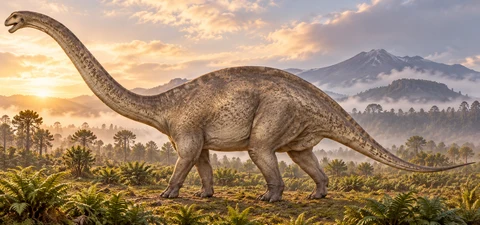
Our illustration uses a separately approved complete Perijasaurus restoration, not the fossil vertebra, for the small head, rising neck, broad torso and long tail. Most body proportions, skin and colour remain artistic interpretations. Compare Patagosaurus and Barapasaurus for other sauropod accounts, then browse the P directory.
Quick answers
- Where was Perijasaurus found?
- Northern Colombia, in the Serrania del Perija region.
- Was it named from a complete skeleton?
- No. The defining fossil is a trunk vertebra.
- What does lapaz refer to?
- The research account connects it with the Colombian peace accords.
- Does the illustration show a completely known body?
- No. It follows a named complete artistic restoration with stated uncertainty.