Jurassic Dinos editorial · Updated · Source-based review
What was Pararhabdodon?
Pararhabdodon isonensis was a lambeosaurine hadrosaurid from Late Cretaceous Europe. Hadrosaurids are commonly called duck-billed dinosaurs, and lambeosaurines form one branch within that group. Its original material came from Tossal de la Doba in the Catalan Pyrenees of northeastern Spain.
Why were additional bones important?
A study published in 2021 described a semi-articulated partial hindlimb and a bone from the underside of the beginning of the tail. Semi-articulated means some original anatomical connection remained, rather than every element being entirely separated. The new material added regions that had previously been poorly documented for the animal.
The tail element was a haemal arch, also called a chevron. These bones lie beneath the tail vertebrae and help define its underside. Learning the vocabulary makes it easier to understand exactly what was discovered instead of imagining that a whole new tail or complete skeleton had appeared.
What is osteohistology?
Osteohistology is the study of microscopic bone structure. Researchers can use it to investigate growth and other aspects of life history that an outside view of a bone may not reveal. The 2021 paper combined that approach with an anatomical description.
The method’s possibilities should not be confused with a specific result that has not been established in the evidence summarised here. This account does not invent an exact lifespan, adult age or growth rate. Those details would require separately checked results, not merely the presence of the word histology in a paper’s title.
Why is identifying fragmentary material difficult?
The authors explain that incomplete fossils and a lack of overlapping diagnostic elements complicate comparisons with other European hadrosaurids. If one animal is known mainly from one part of the skeleton and another from a different part, testing whether they are distinct becomes harder. Finding fossils near one another is not enough to solve that problem automatically.
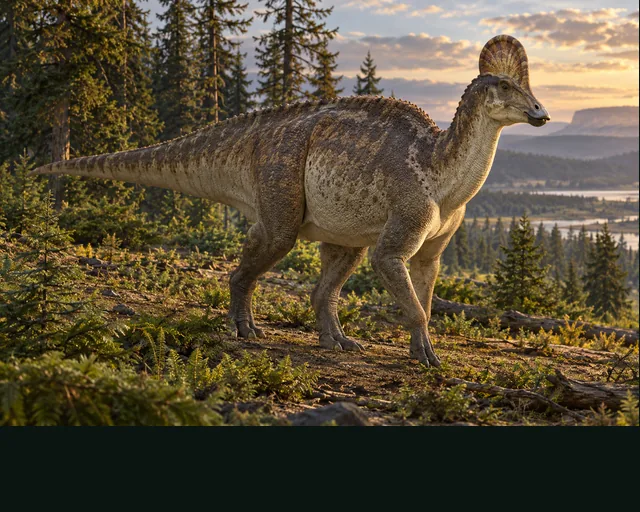
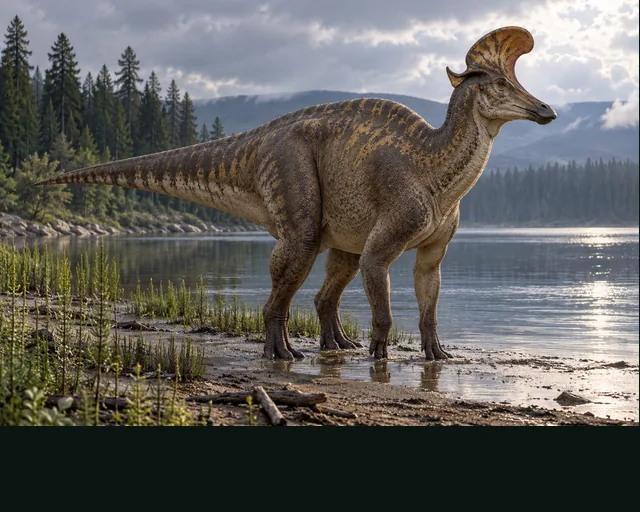
Our image follows a named complete Pararhabdodon restoration, including its low crest, deep trunk and long tail. The crest outline, skin bumps, colours and living posture remain artistic rather than newly preserved evidence. Compare the separate accounts for Lambeosaurus and Corythosaurus, then browse the P directory for more discoveries and sources.
Quick answers
- Where did Pararhabdodon live?
- The region now known as northeastern Spain.
- Which group includes it?
- Lambeosaurine hadrosaurids, a branch of the duck-billed dinosaurs.
- What did the 2021 study add?
- New hindlimb and tail material, together with microscopic bone study.
- Is the exact crest shape directly established here?
- No. The complete living image retains the reference artwork interpretation.