Jurassic Dinos editorial · Updated · Source-based review
What was Paralititan?
Paralititan stromeri was a giant titanosaurian sauropod from Late Cretaceous Egypt. Its name means tidal giant, linking an enormous long-necked dinosaur with the coastal deposits in which its remains were found. The discovery is an opportunity to explore both a remarkable animal and the environment that preserved it.
What evidence supports its great size?
The original 2001 description highlighted a very large humerus, the upper-arm bone. Such a robust limb element provides evidence for an exceptionally large animal. However, a large bone does not give an exact total body mass without further assumptions about the missing skeleton and body proportions.
Historical statements comparing the largest bones known at the time should not automatically be repeated as present-day records. New discoveries can change those rankings. This account therefore describes the animal as giant without claiming a precise weight or a permanent place in a largest-ever league table.
Was its head discovered?
The Natural History Museum describes a partial postcranial skeleton and explicitly notes that no skull was found. Postcranial means behind the head. A realistic face in a painting must therefore be distinguished from a preserved Paralititan skull.
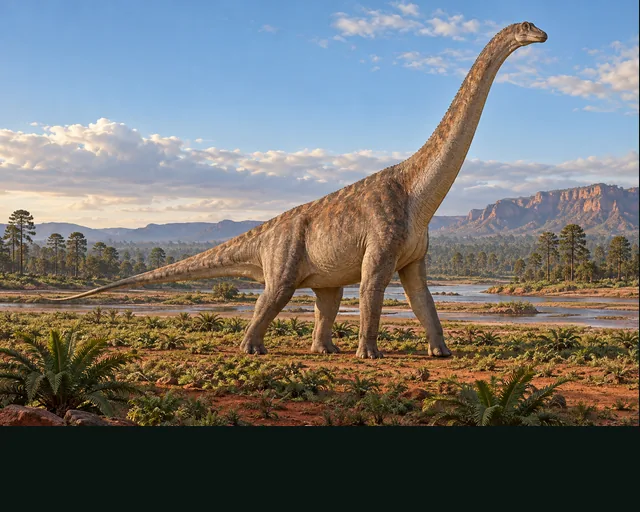
Our image follows a complete living museum restoration specifically labelled Paralititan, including that artwork’s interpreted head. We have not used a fossil photograph or selected a different dinosaur to invent a missing face. The illustration makes the animal easier to imagine while retaining the uncertainty already present in its source.
What does the mangrove deposit tell us?
The skeleton was preserved in coastal deposits of the Bahariya Formation, associated with an ancient mangrove setting. The original paper described evidence of scavenging and raised the possibility that these dinosaurs and their predators regularly entered such environments. A possibility should not be rewritten as a directly observed daily routine.
Burial environment, habitat use and swimming ability are different questions. Coastal sediments provide context without proving that a giant sauropod lived permanently in water. Our independent scene keeps its feet on visible ground near coastal vegetation. Colour and soft tissues remain artistic. Compare Argentinosaurus and Giraffatitan, then visit the P directory.
Quick answers
- What does Paralititan mean?
- Tidal giant.
- Was a skull discovered with its skeleton?
- The museum explicitly reports no skull.
- What kind of deposit preserved it?
- A coastal mangrove deposit of the Bahariya Formation.
- Does the deposit prove every aspect of its daily habitat?
- No. The original paper framed habitual use as a possibility.