Jurassic Dinos editorial · Updated · Source-based review
What was Paralitherizinosaurus?
Paralitherizinosaurus japonicus was a Late Cretaceous therizinosaurid from Hokkaido, northern Japan. Therizinosaurs were an unusual theropod branch that included animals interpreted as plant-eaters despite their impressive claws. This discovery helps show why a large claw does not automatically identify a flesh-tearing predator.
What did the researchers re-examine?
The material came from the lower Campanian Osoushinai Formation near Nakagawa Town. It had previously been recognised as a possible therizinosaur, but its more specific identity remained unresolved. A 2022 study re-examined it and identified a distinctive combination of characters supporting the new genus and species. Re-examination can therefore reveal more about an existing specimen without requiring a second excavation.
The diagnosis involved a metacarpal, one of the bones between the wrist and fingers, and unguals, the terminal claw-bearing bones. These can contain useful identifying features without preserving a complete hand, arm or living body outline. The new name therefore does not imply that a whole feathered skeleton was discovered.
How might the claws have worked?
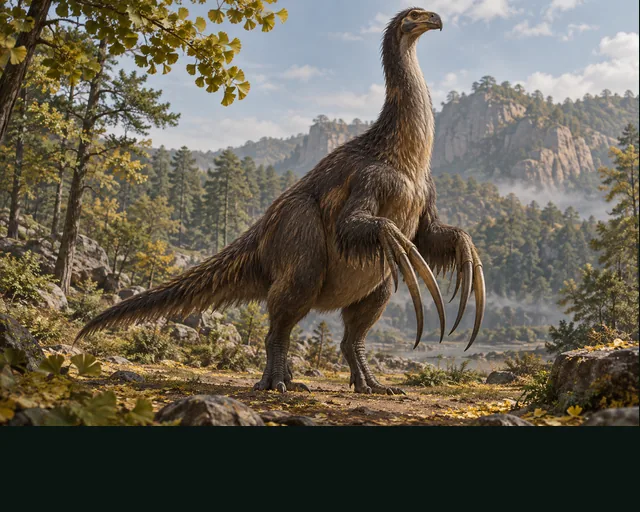
The researchers compared claw shapes and their mechanical properties across therizinosaurs. They found the slender claws relevant to a hook-and-pull interpretation: bringing vegetation closer to the mouth. A flexor tubercle is a projection associated with the attachment of tissues that bend a digit; its development affects such functional comparisons.
This is an inference from anatomy and analysis, not an observation of the living dinosaur eating. It suggests a plausible use while leaving the exact plant menu and frequency of different actions uncertain. The hand of another newly described therizinosaur should not be imported simply because both animals have similar group names.
Does the marine rock mean it lived underwater?
No. The fossil came from marine deposits, which record where the material was buried. That does not alone demonstrate habitual swimming or a fully aquatic lifestyle. The original study discussed coastal environments, a more careful interpretation than turning the animal into a sea-dweller.
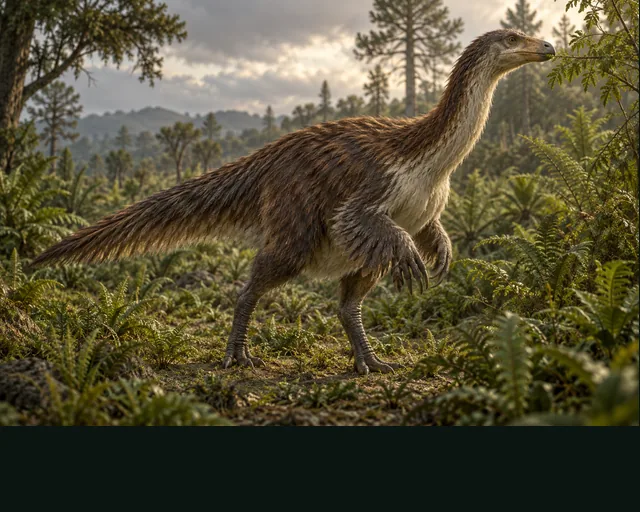
Our image follows the approved complete Paralitherizinosaurus artwork, with a small head, upright neck, feathered trunk, long claws and feathered tail. Missing body proportions and covering remain interpretive. Compare Therizinosaurus and Beipiaosaurus, then browse the P directory.
Quick answers
- Where was Paralitherizinosaurus found?
- Hokkaido in northern Japan.
- Do big claws automatically mean a meat-eating predator?
- No. The study supported a vegetation-hooking interpretation.
- Does a marine deposit prove it swam in the sea?
- No. Burial setting is different from proof of habitual swimming.
- Is its complete feathered outline directly preserved?
- No. It follows an approved named living restoration with uncertainty.