Jurassic Dinos editorial · Updated · Source-based review
What does the name Pantydraco refer to?
Pantydraco caducus is the name given to juvenile sauropodomorph material from South Wales. The genus name combines a reference to Pant-y-ffynnon with dragon. It does not imply wings, fire or any other fantasy feature. Its scientific interest lies in early dinosaur anatomy and the difficulty of recognising species from growing individuals.
Why has its name changed?
The material was first discussed under Thecodontosaurus and named Thecodontosaurus caducus in 2003. A 2007 publication assigned it to the separate genus Pantydraco. Moving a species between genera changes the classification of the same evidence; it does not mean another animal was discovered each time the wording changed.
The Natural History Museum describes a partial juvenile skeleton. A 2026 study identifies the holotype as NHMUK PV RUP24 and discusses it in a Late Triassic, Rhaetian context. Older summaries can give a different age label, so this account follows that more specific recent specimen discussion rather than combining incompatible labels into one precise date.
Why does juvenile status complicate identification?
Growing animals can differ from adults in proportions and the development of particular features. Researchers must ask whether an apparent distinction is characteristic of a separate species or simply associated with growth. That question becomes harder when the available material is incomplete.
A 2020 redescription of Thecodontosaurus found poor anatomical support for separating Pantydraco caducus from Thecodontosaurus antiquus. The authors suggested that the former might represent a juvenile of the latter. This is a substantive challenge to independent validity, so the name is marked as disputed here rather than presented as an unquestioned additional animal.
Does disputed mean the fossils are unreal?
No. The fossils and their locality remain real even if their best name changes. The uncertainty concerns how they should be classified, not whether an early dinosaur lived in the region. Equally, a proposed synonymy should not be described as universal agreement when different publications continue to use the name.
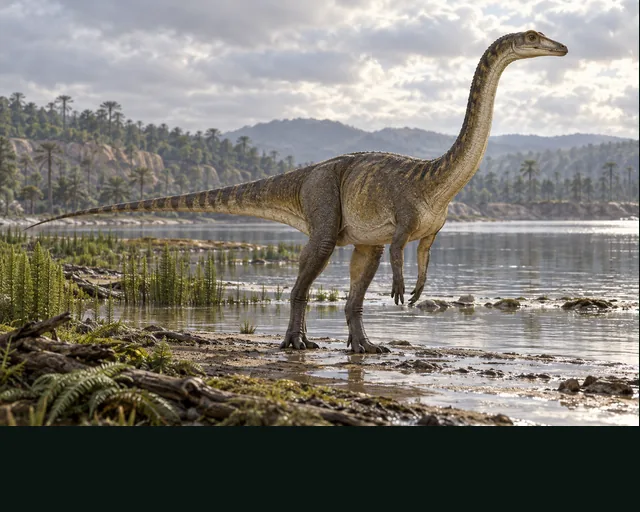
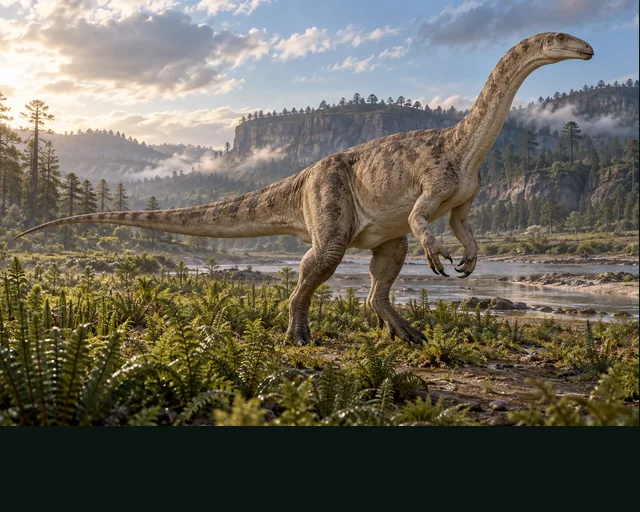
Our illustration follows a complete restoration explicitly labelled Pantydraco, with a small head, slim neck, grasping arms and long tail. It does not predict an exact adult size or reconstruct an exterior from bones. Compare Plateosaurus and Massospondylus, then browse the P directory. Colours and soft tissues remain interpretive.
Quick answers
- What does Pantydraco mean?
- It refers to Pant-y-ffynnon, the Welsh locality, with dragon.
- Was the described animal an adult?
- The material is juvenile.
- Is its independent identity unquestioned?
- No. A 2020 study questioned its distinction from Thecodontosaurus antiquus.
- Does dragon mean it had wings or breathed fire?
- No. It is part of the scientific name, not evidence for fantasy anatomy.