Jurassic Dinos editorial · Updated · Source-based review
What was Panphagia?
Panphagia protos was a small early sauropodomorph from Late Triassic Argentina. Its fossils came from the Ischigualasto Formation in San Juan Province, in rocks assigned to the Carnian stage. Sauropodomorphs include the lineage that later produced giant long-necked sauropods, but its early members did not all share the giants’ body shape or way of life.
Why is it called all-eating?
The original naming paper explains that Panphagia refers to inferred omnivory: a diet involving both animal and plant foods. The researchers interpreted its anatomy as relevant to the transition between carnivory and herbivory. This is a dietary hypothesis, not evidence that a complete list of meals was preserved.
Teeth provide useful clues because their shape affects how food can be handled. However, interpreting a feeding pattern from anatomy is different from identifying actual stomach contents. The name all-eating should not be taken literally to mean it could consume every substance or that we know each food item it encountered.
What did the fossil preserve?
The type specimen, PVSJ 874, includes parts of the skull and lower jaws, vertebrae and several limb and girdle elements. The bones were disarticulated but found in close association. Disarticulated means they were not still joined together in their original positions.
The authors identified the individual as immature from features including unfused connections. That matters because a young individual’s dimensions should not automatically be advertised as the species’ final adult size. This account therefore avoids turning an estimate for one incomplete youngster into a precise adult measurement.
Why is an early branch important?
The 2009 analysis placed Panphagia near the beginning of the sauropodomorph family tree. Such a position helps researchers ask when characteristic features developed. It does not establish that this particular species was the direct ancestor of every later sauropod. A branching relationship and a demonstrated ancestor are different claims.
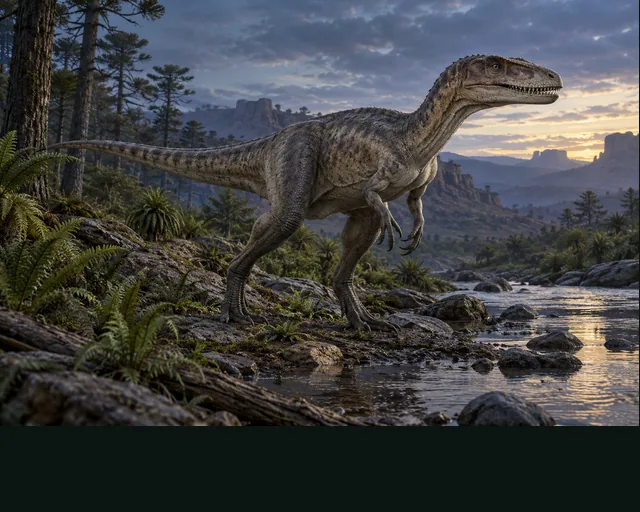
Our image follows an approved complete Panphagia restoration with an elongated head and neck, grasping forelimbs, bipedal hindlegs and long tail. Colour and unpreserved soft tissues remain artistic. Compare Eoraptor and Herrerasaurus for separately researched early dinosaurs, then visit the P directory.
Quick answers
- What does its name refer to?
- An inferred all-eating, or omnivorous, diet.
- Were actual meals preserved with the described animal?
- The reviewed naming evidence is anatomical, not a preserved menu.
- Was the known specimen fully grown?
- The original description identifies it as immature.
- Was it a giant four-legged sauropod?
- No. It was an early small-bodied sauropodomorph.