Jurassic Dinos editorial · Updated · Source-based review
What is Otodus?
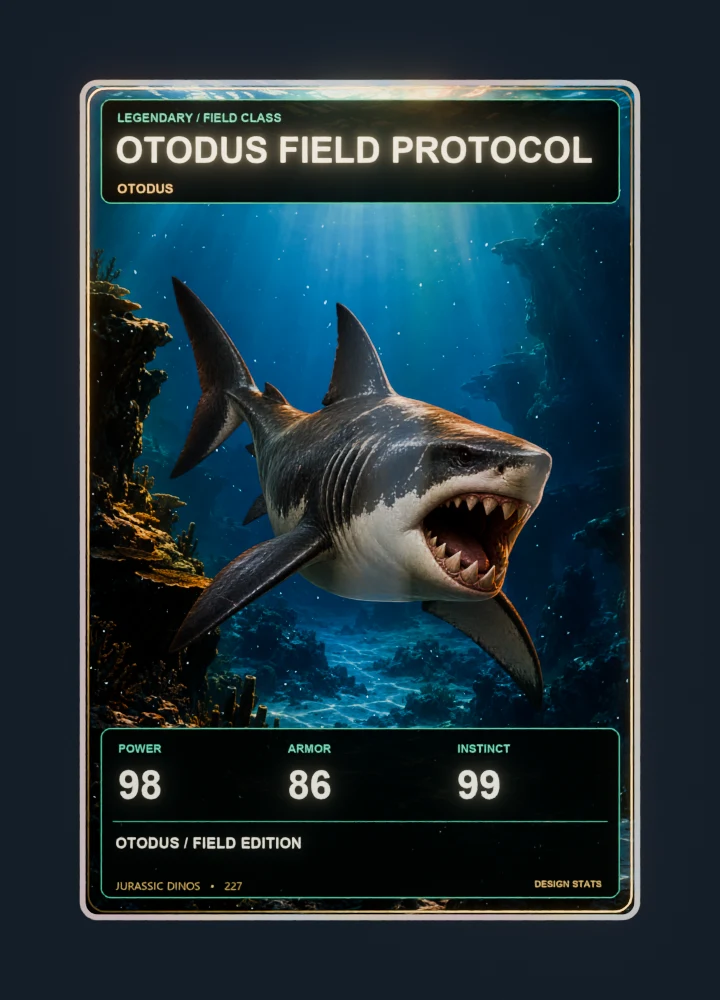
Otodus was a widespread shark genus extending from the Paleocene into the Pliocene.
Distinctive features and evidence
The genus spans multiple species and a much longer interval than any one species. Megalodon belongs to this later shark story, so it should not be placed in a dinosaur-period community simply because a game features both.
Genus overview and research references.
Is Otodus a dinosaur?
No. Otodus is a genus of sharks. It belongs to the mackerel sharks (the order Lamniformes) and to an extinct family called Otodontidae, and like all sharks it had a skeleton made of cartilage rather than bone. Dinosaurs belong to the reptile line, while sharks are fish, a separate branch of vertebrates that breathe with gills.
Otodus also lived at the wrong time to share a world with the dinosaurs of the popular imagination. The genus is recorded from the Paleocene to the Pliocene, which is after the end-Cretaceous extinction that ended the non-bird dinosaurs. The best-known member, Otodus megalodon, lived from roughly 23 to 3.6 million years ago, tens of millions of years after the last dinosaurs such as Triceratops. Our not-dinosaurs page explains more about animals that are often mixed up with dinosaurs.
Otodus fossil discoveries
Almost everything we know about Otodus comes from teeth. They are large, triangular, and have smooth or finely toothed cutting edges, and they survive well because tooth enamel is hard. Cartilage rarely fossilises, so only a few species are also known from vertebral centra, the disc-shaped bodies of the backbone bones, and megalodon is also represented by fossil droppings that are spiral in shape.
A remarkable partial backbone of a megalodon was found in Belgium in 1926. It has around 150 vertebrae, and the centra range from 55 to 155 millimetres across. A second partial column from the Gram Formation of Denmark was excavated in 1983. Because no complete skeleton exists, reconstructions of the whole animal are scaled from these remains and from living sharks.
People noticed the teeth long before scientists understood them. Roman writers described such teeth as stone tongues, and medieval Europeans believed they had magical or medical powers. The Italian naturalist Fabio Colonna argued in 1616 that they were really shark teeth, and Niels Steensen developed that idea in the 1660s. Scientific names came from the Swiss naturalist Louis Agassiz: he named megalodon in the 1830s and 1840s and is the author credited for the genus Otodus in 1838.
Is megalodon the same as Otodus?
Megalodon is one species within the genus, Otodus megalodon, whose name means “big tooth”. For many years it was placed in the genus Carcharodon with the great white shark, because the teeth look alike, and then in a separate genus, Carcharocles. Most researchers now regard the similarity to the great white as convergent, meaning it evolved independently, and treat the megatooth sharks as part of Otodus. Researchers noticed that Otodus would not be a natural group without them, once a related shark named Megalolamna was found in 2016.
The usual picture is that Otodus grew out of a Cretaceous shark called Cretalamna, with species such as Otodus obliquus, which is recorded from the Paleocene to the Miocene, and later forms, such as Otodus auriculatus, angustidens and chubutensis, leading to megalodon. Over that time the teeth became broader and more triangular and gained finer serrations. The shape of the teeth fits a shift from grasping fish to cutting larger prey, although this link has been questioned in studies of tooth stress. Within the mackerel sharks, the great white has its nearest living kin among the mako sharks, not among the megatooth line.
How big was Otodus megalodon?
Nobody knows exactly, because there is no complete skeleton. Published maximum lengths for megalodon range from about 14 to 24 metres, depending on the method. A 2015 analysis of hundreds of teeth estimated that the typical individual of any age was about 10.5 metres long, and older species of Otodus were smaller. One summary lists maximum lengths of about 9.5 metres for Otodus auriculatus and 13.5 metres for Otodus chubutensis.
The highest recent number comes from Kenshu Shimada and colleagues in 2025. They noted that the Belgian vertebral column was longer than a great-white-style body would predict, so megalodon was probably slimmer than the great white, and they estimated that it could have reached about 24.3 metres and a weight near 94 tonnes. Earlier models based on the great white gave lower numbers, with Cooper and colleagues proposing in 2022 a body of about 16 metres. Both groups use the same fragmentary evidence, so large uncertainties remain. In all these studies, the best-supported statement is that megalodon was among the largest predatory sharks ever.
What did Otodus eat?
Otodus is regarded as a top predator. Its teeth show that it fed on fish, sea turtles and marine mammals. Bite marks and gouges on fossil whale ribs, flippers and tail vertebrae, some without signs of healing, support active attacks, and a tooth from a small sperm whale carries marks that fit a bite to the head. Scavenging cannot be excluded for every case.
Diet probably changed with age: young megalodon seem to have eaten more fish and smaller prey, while adults moved offshore and took larger whales. A 2022 study built the first 3D model of the body of megalodon from an exceptional fossil, and estimated that an adult could eat prey the size of modern apex predators and that it could cruise faster than any living shark, which is interesting but is a model. A 2008 estimate scaled up from a great white gave a bite force of around 108,000 to 182,000 newtons for megalodon, but this too is an extrapolation.
Where and when Otodus lived, and why it vanished
Otodus was found across the world: fossils come from Africa, Asia, Europe, North and South America, the Caribbean and Australia. The Paleobiology Database lists a wider time range for the genus than other summaries, so the Paleocene-to-Pliocene span here follows the shorter, more cautious one.
Megalodon itself appears in the Miocene, and one review of the evidence put its extinction early in the Pliocene, about 3.6 million years ago, rather than at the end of that epoch. Claims of younger teeth are treated as unreliable. Researchers suggest several causes working together: cooling oceans, lower sea levels that removed shallow nursery areas, and changes in the whales that formed its food. A 2023 chemistry study of teeth found evidence that megalodon kept its body warmer than the surrounding water, and the authors suggested that the cost of such a large, warm body may have made it vulnerable. Fossil sites dominated by small individuals have been read as nursery areas where young megalodon grew up, although the 2025 size study argued that nurseries were less likely to be needed, so this is still debated.
Otodus in the game
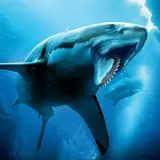
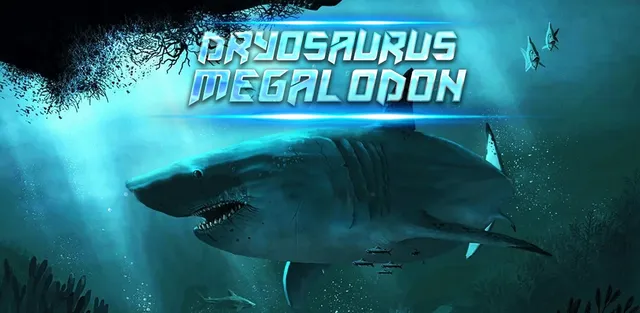
Megalodon Dino Survival Sim lets you play as a Megalodon. Its listing describes ocean exploration, combat, finding other Megalodons to form a family and raise young, and levelling up with new skills.
The game puts the shark in the same ocean as Mosasaurus and other Mesozoic animals, which is fiction, since Otodus megalodon lived millions of years after those animals died out. The game’s story, combat and family system are entertainment and not scientific evidence.
Classification and fossil record
The Paleobiology Database taxonomic record catalogues Otodus under Otodontidae. This is the immediate parent in that catalogue, rather than a complete list of evolutionary relationships.
Research starting point
The catalogue links Otodus to Agassiz, 1838, published in Recherches Sur Les Poissons Fossiles. Tome III (11me livraison). This identifies a research starting point; the catalogue’s citation alone does not verify every later reconstruction or species assignment.
For the meaning of taxonomic terms and how evidence is checked, see the glossary and editorial policy.
Quick answers
- Is Otodus a dinosaur?
- No. Otodus is an extinct genus of mackerel sharks with a cartilage skeleton. Sharks are fish, not reptiles, and Otodus lived after the non-bird dinosaurs had died out.
- When did Otodus live?
- The genus is known from the Paleocene to the Pliocene. Its best-known species, Otodus megalodon, lived roughly 23 to 3.6 million years ago.
- How big was Otodus?
- It varied by species. Older species were smaller, while megalodon is estimated at roughly 14 to 24 metres at maximum. These figures are uncertain because no complete skeleton has been found.
- Is megalodon the same as Otodus?
- Megalodon is one species of Otodus, Otodus megalodon. It was once placed in other genera because its teeth look like those of the great white shark.
- What did Otodus eat?
- Large fish, sea turtles and whales. Bite marks on fossil whale bones suggest active attacks, though the diet of the older species is less well documented.
- Where was Otodus found?
- Fossils come from Africa, Asia, Europe, North and South America, the Caribbean and Australia, showing that the genus lived in oceans around the world.