Jurassic Dinos editorial · Updated · Source-based review
What was Oryctodromeus?
Oryctodromeus was a small Cretaceous plant-eater from western North America. It is particularly famous for fossil evidence associated with a burrow. This makes it a valuable example of studying behaviour through both an animal’s bones and the structure in which those bones were found.
What makes the fossil distinctive?
Its shoulders and forelimbs have features consistent with moving soil, while its hindlimbs retained a running dinosaur’s general proportions. It was not built like a highly specialised modern mole. An animal can use a shelter or excavate a burrow without spending its entire life underground, so digging and running adaptations need not be opposites.
Where was it found and how was it named?
The original Blackleaf Formation material includes an adult and juveniles associated with a preserved underground structure. Additional skeletons come from the Wayan Formation. The combination of burrow shape, occupants and relevant skeletal features is more persuasive than inferring digging from a name alone. The name itself combines ideas of digging and running.
What can we infer, and what remains uncertain?
The association of differently sized individuals has prompted discussion of sheltering and care of young, but a fossil deposit cannot reveal every detail of family behaviour. Later specimens also preserve hardened tendons, complicating early assumptions that burrowing required an entirely flexible, tendon-free tail. This is how science advances: new bones can revise a simple story without erasing the broader evidence for digging. Compare its arms with those of another small bipedal plant-eater rather than with a giant four-legged dinosaur.
Does a burrowing dinosaur have to look like a mole?
No. Oryctodromeus combined a bipedal body with more modest digging adaptations. Living animals also vary greatly in how much they excavate and how often they use burrows.
How can you check the evidence?
The Paleobiology Database record catalogues Oryctodromeus under Orodrominae. Its linked bibliography identifies this research starting point: D. J. Varricchio, A. J. Martin, and Y. Katsura. 2007. First trace and body fossil evidence of a burrowing, denning dinosaur. Proceedings of the Royal Society of London B 274:1361-1368. Open the bibliographic record. A catalogue entry establishes the source trail; it does not independently verify every later illustration or behavioural claim.
Use the dated genus overview to follow the references behind the discovery and anatomy discussed above. When sources disagree, compare which specimen and rock layer each author studied. A reconstructed whole animal can combine original bones with comparisons to relatives; those two kinds of evidence should not be confused. The account above explains the particular limits that matter for Oryctodromeus, rather than supplying unsupported size, speed or lifespan figures.
Read the image and keep exploring
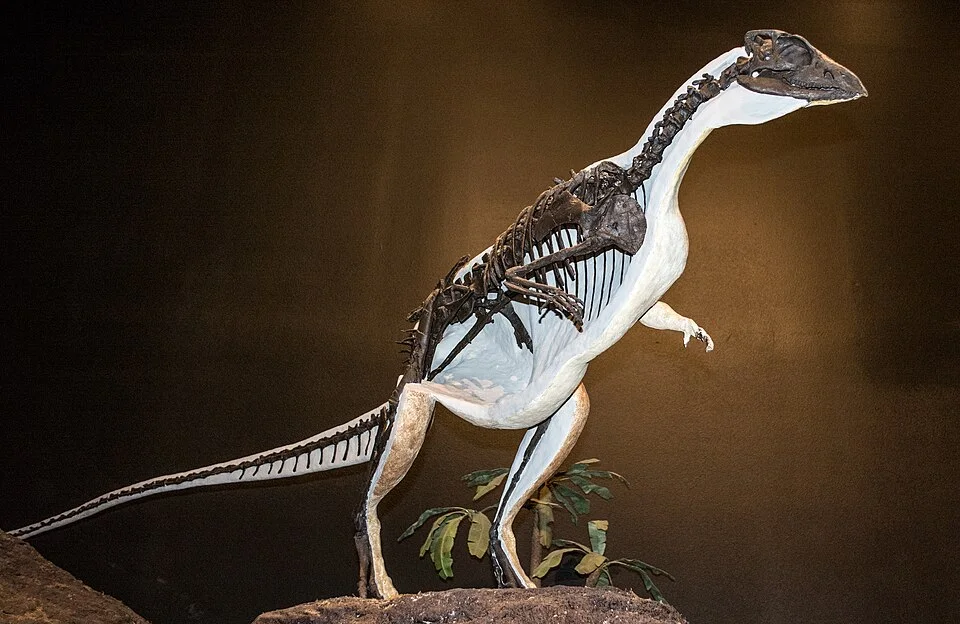
An Oryctodromeus museum model combines a body outline with skeletal anatomy to explain the reconstructed animal. A displayed specimen or skeletal mount can include restored parts. Its appearance should be read alongside the original specimen description.
Compare Dryosaurus, Hypsilophodon, Lesothosaurus. Find more names in the O index and explore ornithischian field notes. The glossary explains unfamiliar fossil terms.
Quick answers
- Where have Oryctodromeus fossils been found?
- The discoveries discussed here come from United States. Modern place names describe discovery locations, not a complete ancient geographic range.
- When did Oryctodromeus live?
- It is placed in the Cretaceous period. See the discovery discussion for qualifications about the particular rock layers and dating.
- Where can I compare Oryctodromeus with related dinosaurs?
- Follow the related field notes below. Comparisons explain shared anatomy; they do not imply that all the animals lived together.