Jurassic Dinos editorial · Updated · Source-based review
What was Ornitholestes?
Ornitholestes hermanni was a small carnivorous theropod from Late Jurassic North America. The Natural History Museum translates its name as bird robber. That memorable name can help you recognise the animal, but it is not a fossilised shopping list or proof that it specialised in catching birds.
How can researchers test an extinct animal’s movements?
A 2006 study by Phil Senter investigated the forelimb using casts of the fossil material. By moving the represented joints, the researcher could examine how far parts of the arm and hand could bend. This is a study of range of motion, rather than a film of the living dinosaur.
The analysis found strong elbow flexion and strong bending at represented hand joints, with little or no movement in the opposite direction at those hand joints. Flexion means bending a joint, such as bringing your forearm closer to your upper arm. Hyperextension means extending beyond its usual straightened position.
Does a possible movement prove a behaviour?
No. Being able to bring the forelimbs close to the body creates several possible uses. It does not independently prove which object an animal held, how often it performed an action or exactly how it caught prey. A mechanical capacity is a useful clue that still needs other evidence for a detailed behavioural story.
The same care applies to the name. Even if catching birds was possible, the words bird robber cannot establish that every meal was a bird. Scientific names often preserve an early interpretation or memorable feature without answering every biological question.
What should we notice in the illustration?
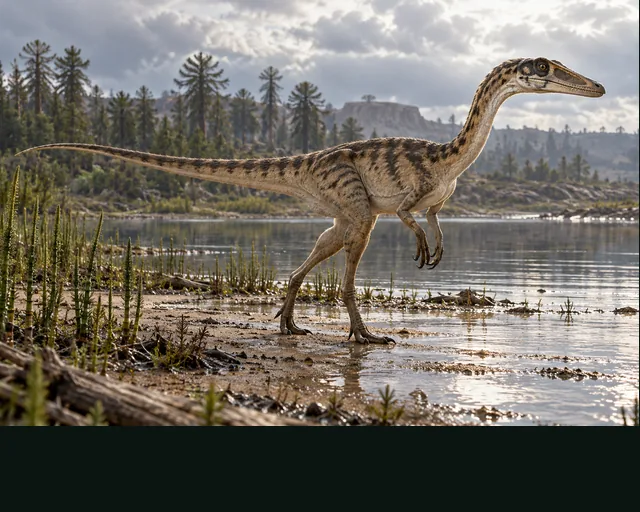
Our picture follows a complete living restoration specifically identified as Ornitholestes. It shows a lightly built body, grasping arms, long hindlegs and slender tail. Fine body filaments and crown feathers follow that artwork, rather than a claim that a feather impression was discovered with this specimen.
Colour, skin and the precise landscape are interpretive. The image adds no projecting nasal horn and does not stage an unsupported prey-catching event. Compare the separate accounts of Compsognathus and Coelophysis for other small theropods, then browse the O directory. Each animal needs its own evidence, even when their outlines seem similar.
Quick answers
- When did Ornitholestes live?
- During the Late Jurassic.
- Does bird robber prove it ate only birds?
- No. A scientific name is not direct evidence for a specialised menu.
- How was arm motion investigated?
- A study manipulated casts of the forelimb to estimate joint movement.
- Are the feathers in the illustration direct fossil evidence?
- No. They follow the approved living restoration and remain interpretive.