Jurassic Dinos editorial · Updated · Source-based review
What was Orkoraptor?
Orkoraptor burkei was a carnivorous theropod from Late Cretaceous southern Patagonia, Argentina. Later research places it among megaraptorans, the group including Megaraptor and Aerosteon. Its name can sound like a familiar sickle-clawed dinosaur, but names alone do not establish anatomy or evolutionary relationships.
What did the original discovery preserve?
The 2008 description was based on partial skull bones, teeth, elements near the beginning of the neck, tail vertebrae and part of a tibia. The tibia is a main lower-leg bone. This material provides clues about the animal without amounting to a complete skeleton or preserved living outline.
Some of its anatomical features initially encouraged comparisons with other coelurosaurian theropods. Later discoveries and analyses helped researchers reassess the wider megaraptoran group. Classification can change as more informative specimens improve the comparisons, even when the original fossil remains physically the same.
Why do sources use different formation names?
The original paper described the material using Maastrichtian Pari Aike terminology. A 2022 comparative account of megaraptorans instead listed Orkoraptor from the Campanian Cerro Fortaleza Formation. These differences reflect revised stratigraphic interpretation, rather than evidence for two separate Orkoraptor discoveries just because the labels differ.
Stratigraphy is the study and correlation of rock layers. Formation names identify rock units, while Campanian and Maastrichtian identify divisions of geological time. Neither should be copied automatically from an old title when later primary research explicitly changes the context. Here the newer terminology is identified as such rather than silently blended with the original account.
Does the name tell us what its hands and feet looked like?
No. The word raptor does not by itself prove a raised sickle-shaped toe or make the animal a close relative of Velociraptor. Likewise, the more complete skeleton described for a different megaraptorid in a later paper cannot be treated as additional Orkoraptor material.
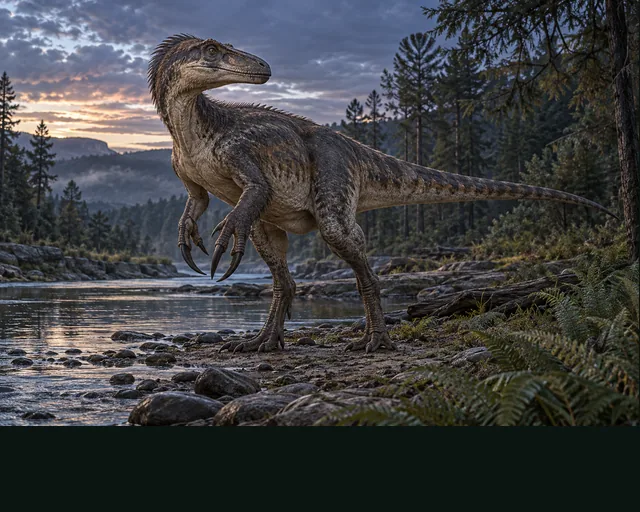
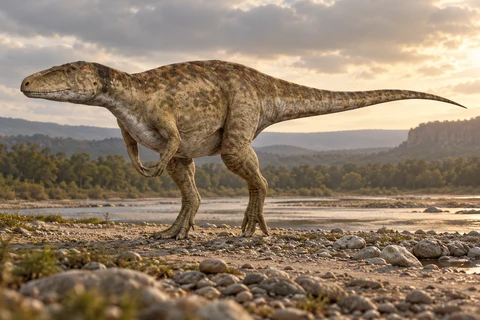
Our picture follows a named complete living restoration with a low head, grasping arms, long hindlegs and feathered tail. The covering, colour and restored proportions remain artistic interpretations, not direct evidence for preserved feathers. Compare the separately researched Aerosteon and Megaraptor, then explore the O directory.
Quick answers
- Was Orkoraptor discovered in Argentina?
- Yes. Its fossils come from southern Patagonia.
- Was a whole skeleton found?
- The original description is based on partial skull and body material.
- Does raptor in its name prove a raised sickle toe?
- No. The name alone does not establish that anatomy.
- Why do older and newer sources give different formation terms?
- Later studies revised the stratigraphic context of the discovery.