Jurassic Dinos editorial · Updated · Source-based review
What was Notocolossus?
Notocolossus gonzalezparejasi was an exceptionally large titanosaurian sauropod from Late Cretaceous Argentina. Its fossils were discovered in Mendoza Province. Titanosaurs included many plant-eating long-necked dinosaurs, but their enormous members can be especially difficult to understand because important parts of their skeletons are rarely preserved together.
Why look at the foot instead of only the size?
The 2016 description highlighted an unusually informative hind foot. Complete feet are scarce among giant titanosaurs, so this material gave researchers a better opportunity to compare how the bones supporting the toes were arranged. The foot had a compact metatarsus, the region between the ankle and the toe bones, together with unusually truncated terminal bones.
The authors interpreted the compact arrangement as relevant to supporting great weight. That is a functional explanation based on anatomy, rather than a direct recording of the animal walking. It still makes the discovery useful for asking how very large land animals stood and moved.
Did all the famous bones belong to one individual?
No. The paper distinguishes a holotype, the specimen carrying the name, from referred material assigned to the same animal. The holotype is numbered UNCUYO-LD 301, while the informative foot belongs to the referred specimen UNCUYO-LD 302. Keeping those records separate prevents a combined diagram being mistaken for one complete skeleton.
The holotype’s exceptionally robust upper-arm bone is one line of evidence for immense size. But a huge limb bone does not automatically reveal an exact total body mass. Estimates depend on methods, comparisons and how missing regions are restored; a single confident-looking number can hide those assumptions.
Does a full-body picture remove the gaps?
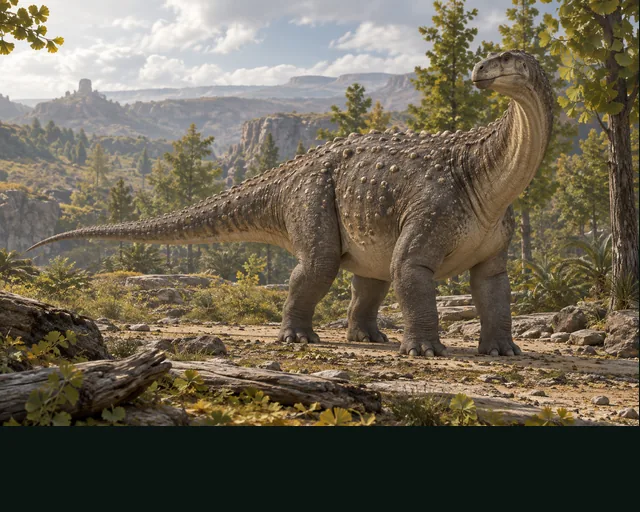
No. A picture can make the animal easier to imagine without increasing the amount of fossil material. Our illustration follows a separately reviewed complete living reconstruction, not the paper’s skeletal diagram. It retains a small head, tall neck, broad trunk, pillar-like limbs and long tail.
The colour, skin and precise living posture remain artistic. The human scale silhouette in the reference was not copied into the new scene or used as an independent measurement. Compare Argentinosaurus and Saltasaurus for other titanosaur accounts, then explore the N directory for more discoveries.
Quick answers
- Where was Notocolossus discovered?
- Mendoza Province in Argentina.
- Why is its foot important?
- Complete hind feet are rare among giant titanosaurs, making comparisons difficult.
- Does the foot belong to the name-bearing specimen?
- The paper distinguishes the holotype from a referred specimen preserving the foot.
- Is its exact total body mass established here?
- No. Very large bones support great size without a single unquestionable mass estimate.