Jurassic Dinos editorial · Updated · Source-based review
What was Neuquensaurus?
Neuquensaurus australis was a Late Cretaceous sauropod from Argentina. It belonged to the titanosaurs, the long-necked dinosaur group that included both extraordinarily large animals and much smaller relatives. The Natural History Museum describes Neuquensaurus as relatively small for a sauropod and identifies it as a plant-eater.
Why is its armour interesting?
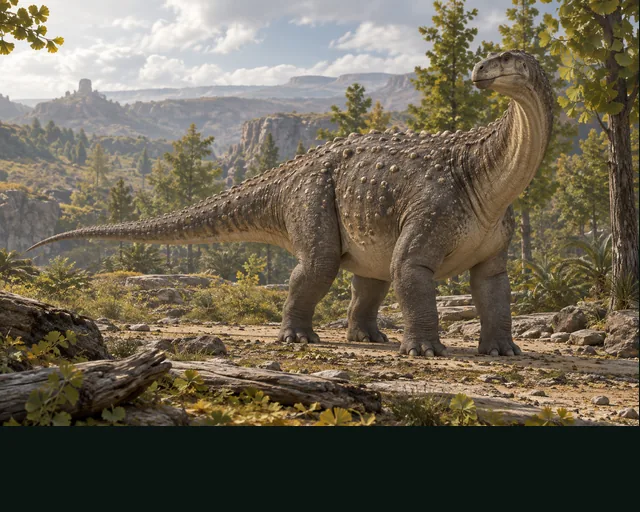
The museum account describes raised, bony scales that could have helped protect the animal. Our complete reference restoration shows rounded armour pieces over the back and flanks, rather than a smooth unarmoured outline. These structures should not be confused with the tall plates of a stegosaur or an ankylosaur’s tail club.
The presence of armour does not give us an exact map of every piece across a living individual’s skin. Nor does it prove that a particular bite was successfully stopped. A possible protective role and a fully observed encounter are different claims. The illustration retains the reference’s interpreted arrangement instead of presenting each bump as a mapped fossil discovery.
Were all titanosaurs giants?
No. Titanosaurs varied greatly in size. Saying that Neuquensaurus was relatively small makes a comparison within a group famous for some enormous members. It does not mean the animal was tiny beside a human, and it does not establish that every small-looking skeleton represents a young giant.
Researchers need separate evidence to distinguish a mature smaller species from a juvenile of a larger one. Likewise, evidence for island dwarfism in another dinosaur cannot simply be transferred to Neuquensaurus. Similar body size alone does not prove an identical growth history or environment.
What does the name tell us?
The museum translates Neuquensaurus as Neuquen River lizard. A geographical name can connect an animal with the region in which its fossils became known. It is not a complete description of its diet, behaviour or preferred habitat, so those questions need other evidence.
Our image uses the approved complete museum restoration for the small head, curved neck, compact trunk, sturdy legs and long tail. Colour, skin detail and the precise living posture remain artistic choices. Compare the separately documented Saltasaurus and Argentinosaurus, then browse the N directory.
Quick answers
- What did Neuquensaurus eat?
- The museum identifies it as herbivorous, meaning plant-eating.
- Where did it live?
- Argentina during the Late Cretaceous.
- What was unusual about its skin covering?
- It had raised bony armour, unlike the unarmoured appearance often associated with sauropods.
- Does relatively small mean tiny?
- No. It is a comparison with other sauropods, not with people or all animals.