Jurassic Dinos editorial · Updated · Source-based review
What was Nemegtomaia?
Nemegtomaia barsboldi was a crested oviraptorid dinosaur from Late Cretaceous Mongolia. Oviraptorids were bird-like theropods, and an important part of this animal’s story involves a skeleton preserved with eggs. Its fossils also reveal why a single desert scene cannot represent every environment in a region’s past.
What is the evidence for brooding?
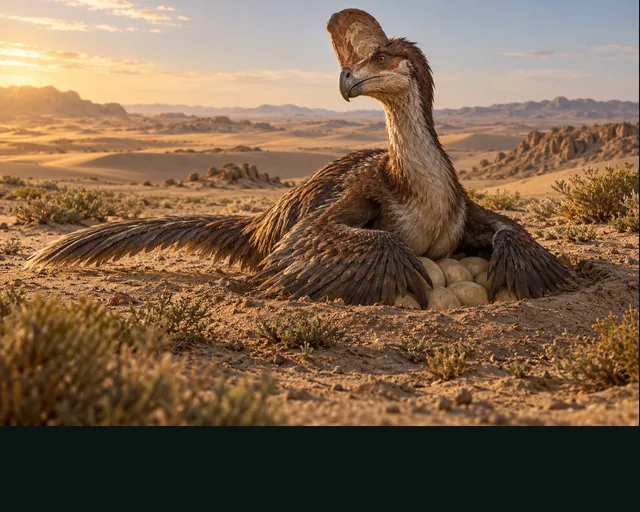
A specimen described in 2012, MPC-D 107/15, was found over a nest in the upper Baruungoyot Formation. The authors interpreted its position as brooding and the animal as an assumed parent. Brooding means attending or covering eggs, as many living birds do.
That interpretation does not determine the individual’s sex. Calling the animal a proven mother would go beyond the evidence. The specimen also suffered damage from beetles before complete burial, but enough diagnostic anatomy remained for the researchers to identify it. Fossils can preserve both an animal’s own structure and traces of events affecting its remains.
Did the original specimen include a nest?
No. The original type specimen, collected in 1996, included a skull and partial skeleton but was not associated with eggs. The nesting specimen was a later discovery. Keeping specimen numbers and discovery histories separate prevents information from one individual being accidentally assigned to another.
The genus name means good mother of Nemegt, yet the naming history began before its own nesting specimen was discovered. The original name Nemegtia had already been used for a different organism, so Nemegtomaia replaced it. A name can express an interpretation without proving a particular animal’s sex or behaviour.
Was its world always a dry desert?
The 2012 paper described another, smaller individual, MPC-D 107/16, from the basal Nemegt Formation. It preserved both hands and thigh bones. The authors discussed the overlap between deposits of the Baruungoyot and Nemegt formations, associated with comparatively arid and wetter river-influenced settings.
The present-day Gobi landscape is therefore not a simple photograph of every habitat these dinosaurs experienced. Our standing reconstruction follows a complete named living reference with a toothless beak, crest, feathered body and tail fan. It does not depict a proven sex or claim direct preservation of every feather. Compare Oviraptor and Citipati, then browse the N directory.
Quick answers
- Where did Nemegtomaia live?
- The region now called Mongolia during the Late Cretaceous.
- Was a specimen found with eggs?
- Yes. MPC-D 107/15 was preserved with a nest in a brooding position.
- Does that prove the individual was female?
- No. Nest attendance alone does not determine sex.
- Were all its specimens found in identical surroundings?
- No. They occur in two formations representing differing depositional settings.