Jurassic Dinos editorial · Updated · Source-based review
What was Musankwa?
Musankwa sanyatiensis was a Late Triassic sauropodomorph from the region now called Zimbabwe. Sauropodomorphs include the lineage that eventually produced the giant long-necked sauropods, but an early member should not automatically be imagined as a miniature version of every later giant.
Its fossils came from the Pebbly Arkose Formation near Spurwing Island on the Lake Kariba shoreline. The original description assigns the rocks to the Norian, a division of the Late Triassic. A geological stage is a way of locating the discovery in time, rather than the animal’s individual age.
What did the researchers actually find?
The described material is an associated right hindlimb: a femur, tibia and astragalus. These are the thigh bone, a main shin bone and part of the ankle. The bones remained articulated, meaning that they retained their connection or close anatomical arrangement.
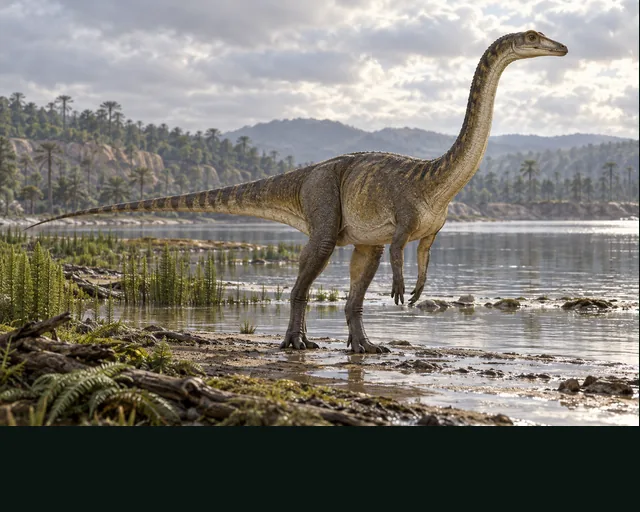
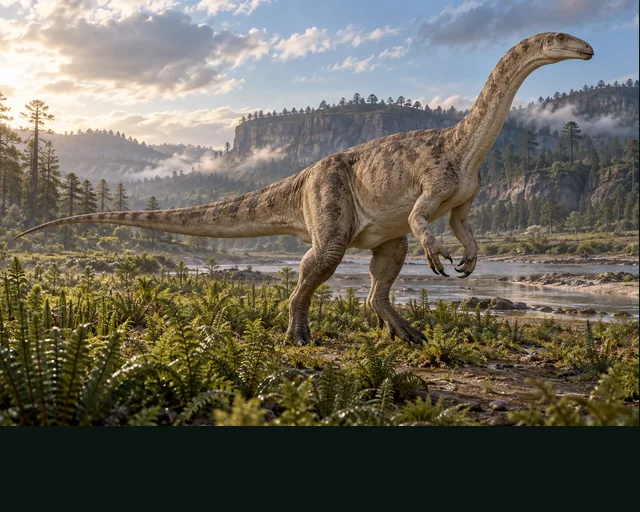
A partial hindlimb can contain a distinctive combination of characters useful for identifying a dinosaur. It does not preserve a complete head, skin or full external body shape. The new illustration therefore follows a separately approved complete living artwork; it was not invented from the hindlimb photographs.
Why does the name mention a boat?
The Natural History Museum’s research announcement explains that the genus honours Musankwa, the boat used by the team as accommodation and a mobile laboratory. The species name refers to the Sanyati River. Scientific names can preserve the practical story of a field expedition as well as a feature of an animal.
The museum reports that the bones were noticed eroding from the shoreline during a 2018 expedition. That detail also explains why careful recording matters: exposed fossils can deteriorate, and information about their position may disappear if a site is not documented.
Was it the oldest member of its group?
The 2024 paper’s analysis placed Musankwa near the base of Massopoda, a sauropodomorph branch. An early-diverging position describes relationships; it does not by itself prove the species is the oldest known by geological date. Those are different questions requiring different evidence.
Our complete reference shows a small head, long neck, deep trunk, grasping forelimbs and long tail. The colour and unpreserved soft tissues remain interpretive. Compare Plateosaurus and Massospondylus, then explore the M directory for more accounts.
Quick answers
- Where was Musankwa discovered?
- On the Lake Kariba shoreline in Zimbabwe.
- Which bones define the described specimen?
- A right thigh bone, shin bone and ankle bone.
- Why was it named Musankwa?
- The name honours the boat used by the research team.
- Does earliest-branching mean oldest by date?
- No. Position in an analysed family tree is different from geological age.