Jurassic Dinos editorial · Updated · Source-based review
What was Murusraptor?
Murusraptor barrosaensis was a carnivorous theropod from Late Cretaceous Patagonia. Its fossils came from the Sierra Barrosa Formation in Neuquén Province, Argentina. Researchers place it among megaraptorans, an unusual group of predators whose wider position in the theropod family tree has been debated.
How much of the animal was discovered?
The type specimen, MCF-PVPH-411, preserves much of the skull together with parts of the backbone, pelvis and a tibia. The tibia is one of the main lower-leg bones. This is a substantial collection of information, but it is not the same as finding every bone or an intact living outline.
The original description identified a distinctive combination of features in the skull and body. These include details of the bones near the eye and lower jaw, as well as the tail vertebrae and pelvis. Scientists use such comparisons to diagnose a species; a dramatic painted claw is not, by itself, a scientific diagnosis.
Was the discovered individual an adult?
Coria and Currie’s 2016 study described the specimen as immature. That means growth was incomplete, not that the animal was necessarily a tiny hatchling. The authors compared its proportions with other megaraptorans and noted a relatively gracile build. Gracile means more slender rather than heavily built.
An immature skeleton does not provide a guaranteed final adult length. Growth rates and body proportions can change, and a missing adult cannot simply be produced by enlarging a picture. This account therefore avoids a precise adult-size claim unsupported by the reviewed evidence.
Why is its family-tree position discussed carefully?
Megaraptorans have appeared in different positions in published theropod analyses. The original Murusraptor study examined competing datasets rather than treating the wider question as already settled. We retain the clear megaraptoran identity without turning one disputed broader placement into an unquestionable fact.
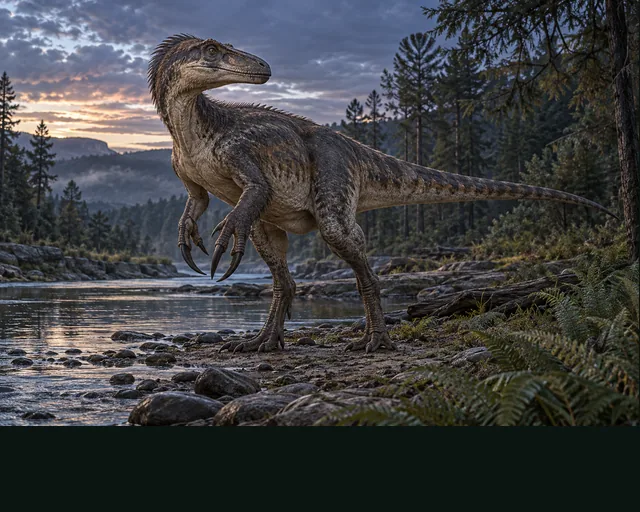
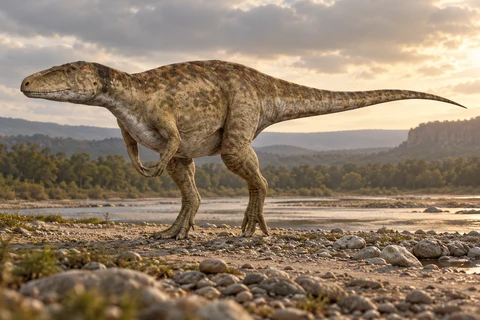
Our image follows an approved complete living restoration specifically labelled Murusraptor. Its filament-like covering and restored hands are features of that artwork, not direct proof that those soft tissues or every finger were preserved with this specimen. Colour, lighting and landscape are also interpretive. Read about Aerosteon and Megaraptor for separately documented relatives, or browse the M directory.
Quick answers
- Where was Murusraptor discovered?
- In the Sierra Barrosa Formation of Neuquén Province, Argentina.
- Was its type specimen fully grown?
- The original study described it as immature.
- Does immature mean newly hatched?
- No. It means growth was not yet complete.
- Do its fossils prove the illustrated filament coat?
- No. The covering follows the approved named artwork and remains an artistic reconstruction.