Jurassic Dinos editorial · Updated · Source-based review
What was Micropachycephalosaurus?
Micropachycephalosaurus hongtuyanensis was a small ornithischian dinosaur from Late Cretaceous China. Ornithischia is the broad dinosaur group that includes many familiar plant-eaters. Its genus name contains twenty-three letters, making it a memorable subject even before the scientific questions begin.
Does thick-headed in the name settle its identity?
The Natural History Museum translates the name as tiny thick-headed lizard. A name can preserve an early interpretation, but it is not a substitute for examining fossils. It should not automatically persuade an illustrator to add a huge dome or convince a reader that every later classification question has been answered.
Even the museum directory illustrates the difficulty: its general type label and its more detailed classification trail point toward different narrower groups. Rather than silently choosing one label and treating it as certain, this account keeps the broader ornithischian identity clear and explains why more specific placement needs care.
What does a recent evolutionary analysis suggest?
A 2026 study describing the Korean dinosaur Doolysaurus also compared other small ornithischians. In one majority-rule result, Micropachycephalosaurus grouped with Koreanosaurus within Thescelosaurinae. Other results in the same analysis were less resolved. That is evidence about a particular analytical result, rather than a declaration that all researchers now agree on one final family tree.
A majority-rule tree summarises groupings appearing across a proportion of the analysed trees. A strict consensus retains only groupings shared by all relevant trees. Those approaches can therefore display different levels of resolution without a fossil changing its anatomy between the two diagrams.
Does the Korean discovery provide its missing biology?
No. A comparative paper includes several animals, but the new Korean specimen’s age, growth stage and stomach stones belong to Doolysaurus. They cannot simply be assigned to the Chinese animal because both appear in one study. Keeping the evidence attached to the correct name is essential.
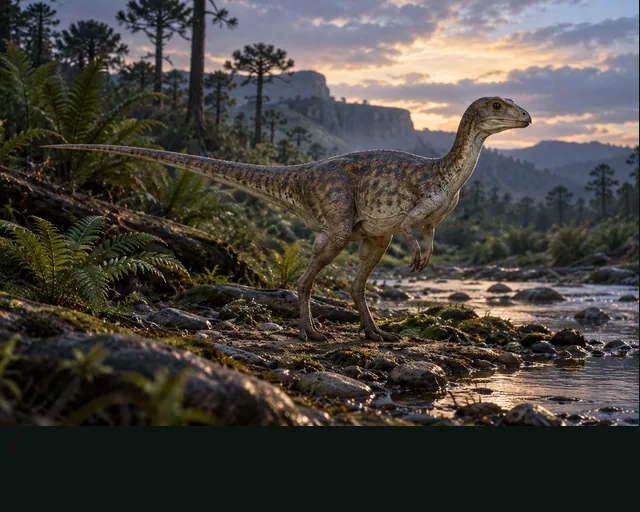
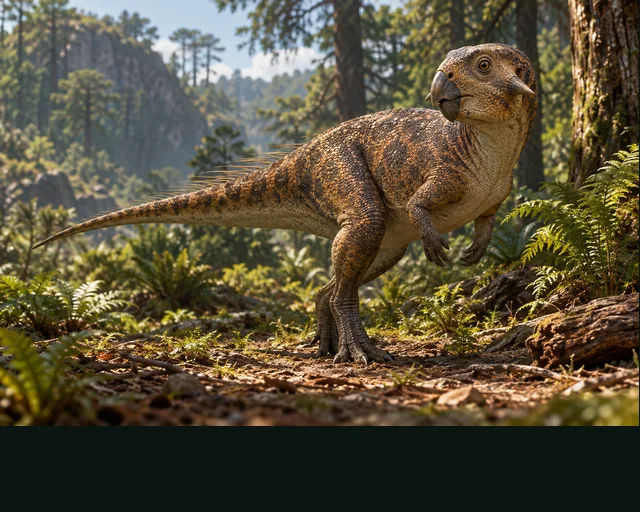
Our illustration follows the approved complete museum restoration: a small head, compact body, short arms, long hindlegs and slender tail. It adds no large dome, horns or frill. Colour and unpreserved soft tissues remain artistic. Compare Lesothosaurus and Psittacosaurus as separate ornithischian accounts, then browse the M directory.
Quick answers
- How many letters are in the genus name?
- Twenty-three, counting Micropachycephalosaurus itself.
- Where did it live?
- China during the Late Cretaceous.
- Does its name prove a large dome?
- No. A scientific name does not substitute for anatomical evidence.
- Is its exact family placement treated as settled here?
- No. We retain the broader ornithischian identity and explain differing analyses.