Jurassic Dinos editorial · Updated · Source-based review
What was Mendozasaurus?
Mendozasaurus neguyelap was a titanosaurian sauropod from Late Cretaceous Argentina. Several partial skeletons came from a single locality in the Coniacian Sierra Barrosa Formation of southern Mendoza Province. A detailed 2018 revision added previously undocumented material and reconsidered the anatomy and relationships of this long-necked dinosaur.
Why can a fossil look too short?
The revision found that some vertebrae in front of the sacrum had not originally been as unusually short as their preserved shape suggested. Instead, the apparent compression resulted from crushing after death and burial. Researchers describe such effects as taphonomic: connected with the processes that affect remains on their way into the fossil record.
This is a different explanation from a living animal having exceptionally compact vertebrae. Before using a measurement in a reconstruction or an evolutionary comparison, researchers must ask whether it records original anatomy, later distortion or a mixture of both. More material can help test which interpretation fits the evidence.
What else did the revision investigate?
The study revised the diagnostic combination of features, including structures on neck and tail vertebrae and the upper arm bone. It also considered foot anatomy and incorporated Mendozasaurus into an expanded analysis of titanosaur relationships. Each part contributes a different kind of comparison; no single dramatic feature has to carry the entire identification.
The analysis placed it among lognkosaurian titanosaurs, alongside several other South American forms. That result concerns proposed evolutionary relationships, not proof that every member shared the same body size, habitat or precise neck posture. A family-tree grouping should not turn differently documented animals into interchangeable giants.
How does our picture handle missing exterior details?
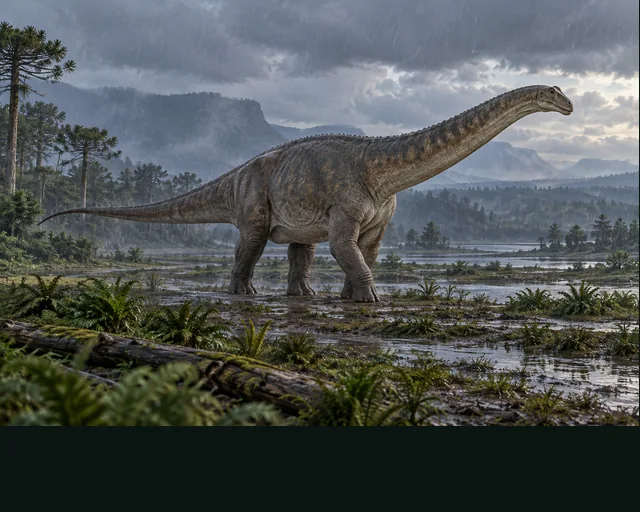
The illustration follows an approved complete living restoration explicitly labelled Mendozasaurus. Notice its long rising neck, substantial trunk, supporting limbs and tapering tail. The skin nodules, colour pattern and exact stance retain the uncertainty of the source artwork. They have not been treated as new facts deduced from crushed vertebrae or isolated foot bones.
Compare Argentinosaurus and Futalognkosaurus as separate accounts, then continue through the M directory. As you compare silhouettes, ask how much of each difference reflects documented anatomy and how much comes from preservation or artistic presentation.
Quick answers
- Where was Mendozasaurus found?
- Southern Mendoza Province in Argentina.
- Was the evidence one complete connected skeleton?
- No. The reviewed study describes several partial skeletons from one locality.
- What is taphonomic crushing?
- Deformation connected with processes after death and during burial.
- Does a compressed fossil automatically show a short-bodied animal?
- No. Researchers must consider distortion.