Jurassic Dinos editorial · Updated · Source-based review
What was Melanorosaurus?
Melanorosaurus readi was an early sauropodomorph dinosaur from Late Triassic South Africa. The Natural History Museum credits its naming to Sidney Haughton in 1924 and explains the genus name as Black Mountain lizard. Sauropodomorphs are the wider evolutionary group that includes the later giant sauropods and their earlier relatives.
Why distinguish it from a former second species?
Older sources may also mention Melanorosaurus thabanensis from Lesotho. A 2016 revision re-examined that material and concluded that it should no longer be assigned to Melanorosaurus. The authors introduced Meroktenos for the Lesotho species.
That decision matters whenever facts are collected under an old name. New anatomical observations, localities or measurements reported for thabanensis cannot simply be added to the account of readi. Although the names once appeared together, the revision asks us to keep the underlying specimens and their evidence separate.
Can a taxonomic revision change geological information too?
The same study revised the geological assignment of the Lesotho fossil, placing it in the Lower Elliot Formation and Late Triassic rather than the previously proposed Early Jurassic. This is information about that specimen. It should not be mistaken for a new discovery of Melanorosaurus readi in a different period.
Two kinds of investigation are happening: deciding which genus a fossil belongs to and determining the age of its rocks. They can influence a wider evolutionary story, but neither should be replaced by a simple list of names copied from an old directory.
What should you notice in the living reconstruction?
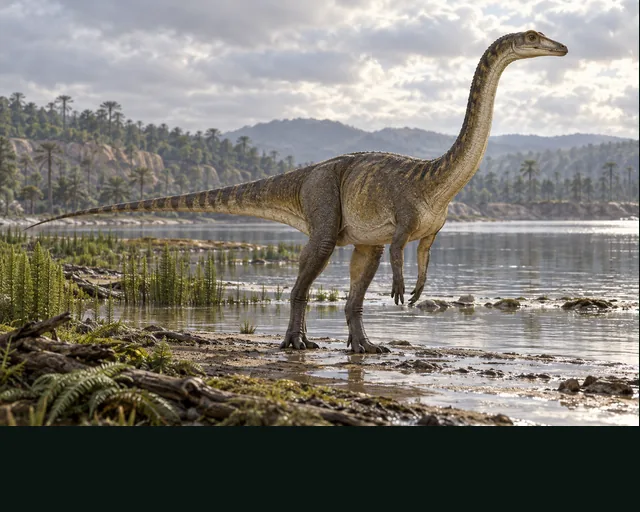
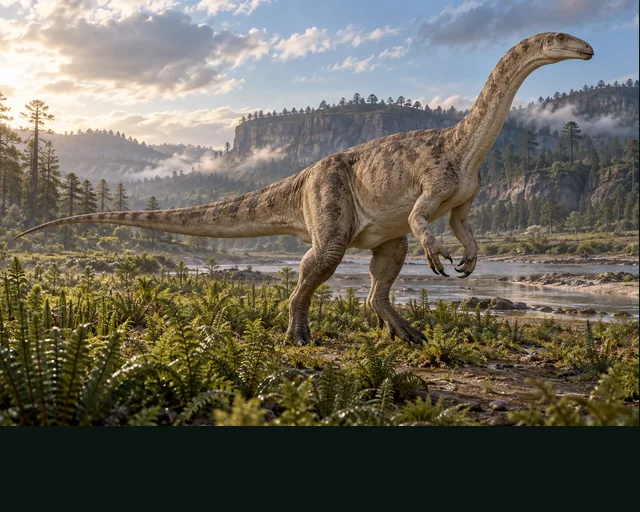
The approved complete museum restoration depicts a broad body, rising neck, sturdy supporting limbs and a long tapering tail. Our illustration follows that named exterior. The exact posture, colours and unpreserved soft-tissue outline remain artistic interpretations, rather than a direct demonstration of how the animal spent every moment of its life.
We also leave its detailed diet unresolved here. A broad directory label does not identify a complete menu, and a large body alone cannot establish which plants or other foods were eaten. Compare Plateosaurus and Massospondylus, then browse the M directory. Keep asking whether a fact concerns the named type, another assigned specimen or an illustration.
Quick answers
- Which species does this account discuss?
- Melanorosaurus readi.
- Where did it live?
- South Africa during the Late Triassic.
- Is the old species Melanorosaurus thabanensis retained here?
- No. The reviewed revision placed it in Meroktenos.
- Does a four-legged picture establish an exact daily diet?
- No. Body pose and dietary evidence are separate questions.