Jurassic Dinos editorial · Updated · Source-based review
What was Maxakalisaurus?
Maxakalisaurus topai was a plant-eating titanosaurian sauropod from Late Cretaceous Brazil. Its fossils come from the Adamantina Formation in Minas Gerais. The name honours the Maxakali people, and the animal was described by Alexander Kellner and colleagues in 2006. A later jaw study added another chapter to its scientific story.
Why was the additional jaw assigned cautiously?
The original skeleton is incomplete and disarticulated, meaning that the bones did not all remain connected in anatomical order. A 2016 paper reported a partial right dentary and isolated teeth from the same fossil site. The researchers tentatively referred that material to Maxakalisaurus.
Tentatively is important. Finding a bone nearby is evidence to consider, but it does not automatically prove that it belonged to the same individual or even the same species. A careful article should preserve the uncertainty in that assignment instead of silently turning the new jaw into part of the name-bearing skeleton.
What do the teeth reveal?
The new jaw includes replacement teeth within the tooth sockets. A working tooth and a developing replacement are different stages of a continuing dental system. This provides information about the arrangement of teeth, although it does not by itself establish a precisely timed replacement schedule or a complete list of food plants.
The study also incorporated the additional anatomical information into an analysis of titanosaur relationships. This illustrates why a small piece of a very large animal can matter: a jaw may preserve characters missing from the rest of the known material and improve comparisons with other named dinosaurs.
Do tooth marks tell a hunting story?
The Natural History Museum notes tooth marks on some bones and suggests scavenging activity. A mark can record contact with a tooth, but an exciting scene of a predator bringing down this particular dinosaur requires more evidence. Feeding on an already dead animal is a different possibility.
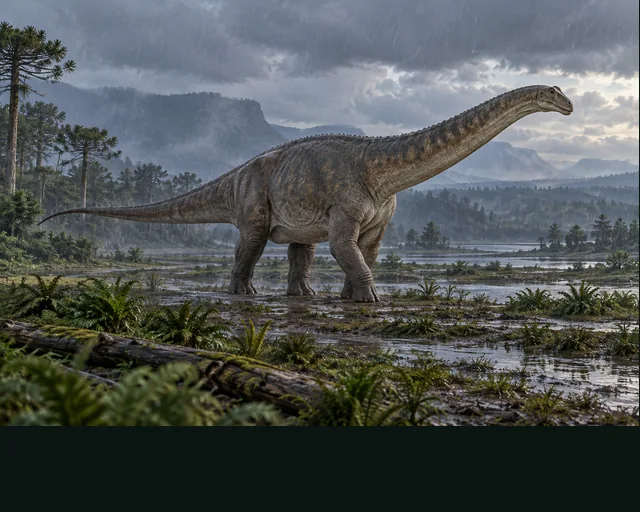
Our complete image follows the approved named museum restoration, including an interpreted arrangement of skin adornments. Colour and the precise distribution of nodules remain artistic. Compare Argentinosaurus and Futalognkosaurus as separate titanosaurs, then continue through the M directory.
Quick answers
- Where did Maxakalisaurus live?
- The region now known as Minas Gerais, Brazil.
- What is a dentary?
- A tooth-bearing lower-jaw bone.
- Was the later jaw assigned with complete certainty?
- No. The study explicitly describes a tentative referral.
- Do bite marks automatically prove a successful hunt?
- No. Feeding on a carcass is another possible explanation.