Jurassic Dinos editorial · Updated · Source-based review
What was Mansourasaurus?
Mansourasaurus shahinae was a titanosaurian sauropod from Late Cretaceous Egypt. Its fossils were found in the Campanian Quseir Formation at Dakhla Oasis in the Western Desert. A team led by Hesham Sallam described the dinosaur in 2018, bringing important new evidence to a relatively poorly sampled part of mainland Africa’s dinosaur history.
Why was the skeleton informative?
The associated partial skeleton includes material from the head as well as other body regions. Associated means that the remains were interpreted as belonging together, not that a complete living outline was preserved. Having several anatomical regions available gives researchers more opportunities to compare the animal with other titanosaurs.
This was particularly valuable because suitable Late Cretaceous land-vertebrate fossils from continental Africa were sparse and often fragmentary. A gap in discoveries is not the same thing as a landscape without animals. Rocks may be inaccessible, poorly exposed or insufficiently collected, leaving a very incomplete record of the former ecosystem.
What did it suggest about continental connections?
The original analysis placed Mansourasaurus among titanosaurs related to forms from southern Europe and eastern Asia. The authors interpreted that pattern as evidence against complete isolation of mainland African dinosaur faunas during the later Cretaceous.
An evolutionary relationship is not a detailed travel diary. It does not identify one exact migration route, prove that an individual swam across an ocean or show the precise moment when a population moved. The broader conclusion concerns possible connections between regions, tested using anatomy, geological ages and geographical history. Later analyses can revise the finer branching pattern as new fossils are added.
Why is it shown in woodland rather than beside pyramids?
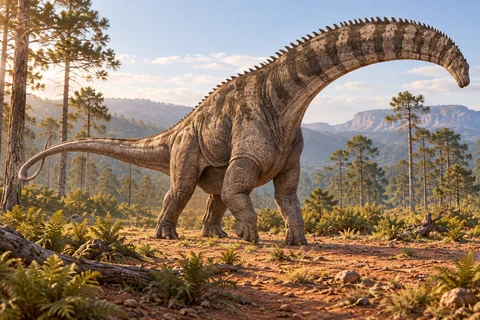
The dinosaur lived long before humans built monuments, and the modern Western Desert is not a photograph of its prehistoric surroundings. Our independently designed woodland is an artistic setting. The animal’s exterior follows an approved complete named restoration, including its interpretation of small skin nodules; their exact arrangement and the colours are not established here from fossils.
Compare Argentinosaurus and Isisaurus as separate titanosaur accounts, then explore the M directory. Comparing regions can reveal useful questions without assuming that every long-necked dinosaur shared the same environment or evolutionary history.
Quick answers
- Where was Mansourasaurus found?
- Dakhla Oasis in Egypt’s Western Desert.
- What kind of dinosaur was it?
- A titanosaurian sauropod.
- Was the whole skeleton complete?
- No. It was an associated partial skeleton including some skull material.
- Does a close evolutionary relationship reveal an exact migration route?
- No. Geography and timing require additional evidence.