Jurassic Dinos editorial · Updated · Source-based review
What was Isisaurus?
Isisaurus was a plant-eating sauropod dinosaur from Late Cretaceous India. It belongs to the titanosaurs, a branch of the long-necked dinosaur family. Its name refers to the Indian Statistical Institute, reminding us that institutions and collections are part of how fossils become scientific evidence.
Why might two naming dates appear?
The Natural History Museum directory associates the species colberti with Jain and Bandyopadhyay in 1997. The exact-name Paleobiology Database record attributes the genus Isisaurus to Wilson and Upchurch in 2003. Those records refer to different parts of a name’s history, rather than necessarily contradicting one another.
A useful way to read scientific names is to treat the genus and species as separate pieces of information. When researchers revise the genus, an older species history can remain important. Before combining dates from different summaries, ask which naming event each source actually means.
What can fossil dung tell us?
A 2005 study examined fungal remains in Lameta Formation coprolites, interpreted as possibly produced by Isisaurus. A coprolite is fossilised dung. Such material can preserve clues about food and surroundings, but linking a particular dropping to a particular dinosaur is an additional inference.
Fungus in dung does not automatically mean that the animal lived entirely on mushrooms. Tiny fungi can be associated with the plants entering a digestive system. The interesting question is how several clues fit together, rather than which surprising item makes the best headline. Keep the proposed producer separate from the material that was actually observed.
How should you read the picture?
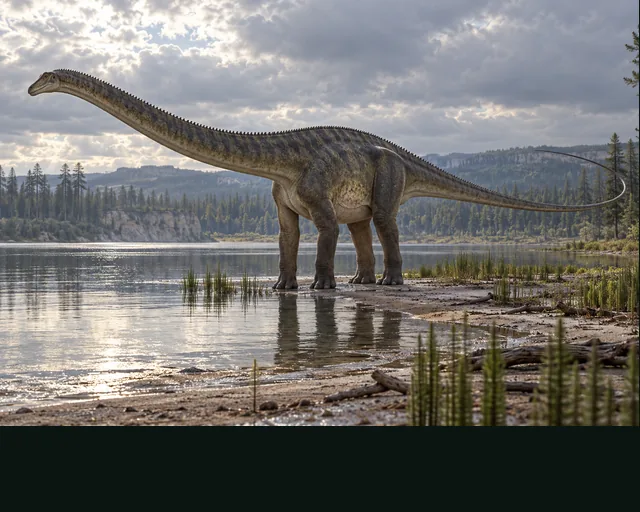
Our restoration follows Andrey Atuchin’s complete Isisaurus artwork published by the Natural History Museum. Trace its curved neck, deep torso, four heavy legs and slender tail. The small dorsal ornaments, skin pattern and curved tail tip follow the reference artist’s interpretation; this scene does not turn them into newly discovered fossils.
The woodland, light and walking moment are independently designed. The museum’s giraffe comparison is a helpful starting analogy, but an analogy does not make the animals anatomically identical or establish the exact reach of the illustrated neck.
Compare Argentinosaurus with Diplodocus to explore two different sauropod accounts, then browse more names beginning with I.
Quick answers
- Was Isisaurus a dinosaur?
- Yes, a titanosaurian sauropod.
- What does its name refer to?
- The Indian Statistical Institute.
- Are fungal remains evidence of a mushroom-only diet?
- No. Fungi can occur on eaten plants.
- Is the picture’s neck pose certain?
- No. It follows the credited artistic reference.