Jurassic Dinos editorial · Updated · Source-based review
What was Manidens?
Manidens condorensis was a small heterodontosaurid dinosaur from Patagonia, Argentina. Heterodontosaurids belong among the early branches of Ornithischia, the wider group that also includes many later plant-eating dinosaurs. Manidens is especially interesting for its teeth, which can be studied at both the visible and microscopic scales.
Why do sources give different Jurassic ages?
The original 2011 description placed its Cañadón Asfalto Formation fossils in the Middle Jurassic. Subsequent studies, including the 2020 enamel paper, use a late Early Jurassic age. The older wording remains in the title of the original paper because a published title records what was written at that time.
This is a reminder to check the geological evidence behind a date rather than copying every older label. A revised age changes the position of a fossil in time; it does not mean the specimen itself moved to another rock layer or that its anatomical observations disappear.
What is distinctive about the teeth?
The original description highlights high crowns on the back teeth and an unusual asymmetric arrangement of denticles, the small projections along a tooth’s edge. Those visible structures help distinguish the animal. The authors also considered how its dentition related to specialised plant processing in other heterodontosaurids.
Another study looked inside the enamel, the hard outer tooth covering. In 2020, researchers described differences between upper and lower teeth in the distribution and organisation of that tissue. Microscopic crystal patterns and the shape of an entire tooth are different scales of evidence, so they can contribute different information to the feeding and evolutionary story.
Was a small tooth simply a miniature version of every larger one?
No. Differences in shape, wear and internal construction matter as well as size. Broad research on heterodontosaurids supports predominantly plant-based feeding, but it does not reveal a complete menu for this particular animal. A pointed tooth alone should not be turned into a detailed hunting story.
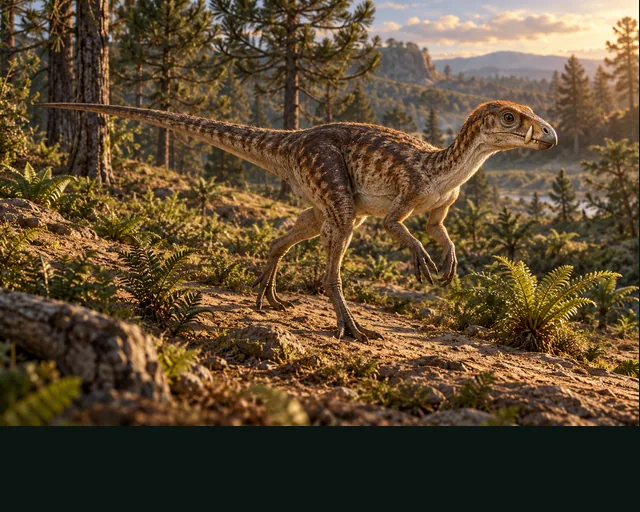
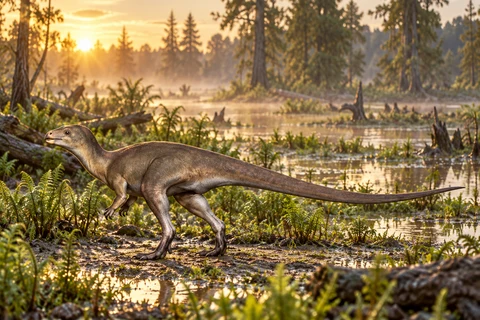
Our image follows the approved complete Manidens restoration, including its source artist’s uncertain filament covering. Colours and the woodland setting remain artistic. Compare Heterodontosaurus and Echinodon, then continue through the M directory.
Quick answers
- What dinosaur group includes Manidens?
- Heterodontosauridae, an early ornithischian group.
- Where was it found?
- Patagonia, Argentina.
- Why does the original paper title say Middle Jurassic?
- Later studies use a late Early Jurassic age instead.
- Is its illustrated filament coat directly established here?
- No. It is an uncertain feature of the named source artwork.