Jurassic Dinos editorial · Updated · Source-based review
What was Echinodon?
Echinodon was a small dinosaur from the Purbeck fossil record of southern England. Its species is Echinodon becklesii. Modern review places it among heterodontosaurids, a distinctive early branch of plant-eating ornithischian dinosaurs that survived into the Early Cretaceous.
Its history began with small jaws described in the nineteenth century. Those remains were initially interpreted differently from their modern dinosaur classification. Re-examining old specimens can therefore change their place in evolutionary history without requiring the fossils themselves to be newly discovered.
What does heterodont mean?
Heterodont refers to having different kinds of teeth. Heterodontosaurids are especially interesting because their jaws can combine enlarged canine-like teeth with other teeth suited to processing food. A single conspicuous tooth does not describe the function of the entire mouth.
The comparison with mammalian canines is only a description of shape. It does not make Echinodon a mammal, and it does not automatically identify it as a predator. Different animals can use superficially similar structures in different ways.
What can tooth wear reveal?
A reviewed study of heterodontosaurids investigated tooth form, replacement and wear. It supported a predominantly or exclusively plant-eating interpretation for the group. Wear can preserve information about how teeth contacted food or one another, adding evidence beyond their unworn outline.
That does not supply a list of every plant eaten by Echinodon. A broad feeding interpretation and a known favourite food are different levels of certainty. This account therefore avoids inventing a precise menu or treating a large tooth as proof of hunting.
Why is the jaw record important?
The known material gives researchers more confidence about parts of the mouth than about the complete living body. A small jaw can contain several identifying characters, while leaving the limbs, tail and outer covering poorly constrained.
This unevenness is normal in palaeontology. Evidence does not have to answer every question to be useful. Good descriptions explain both the informative structures and the regions that remain uncertain.
Reading our reconstruction
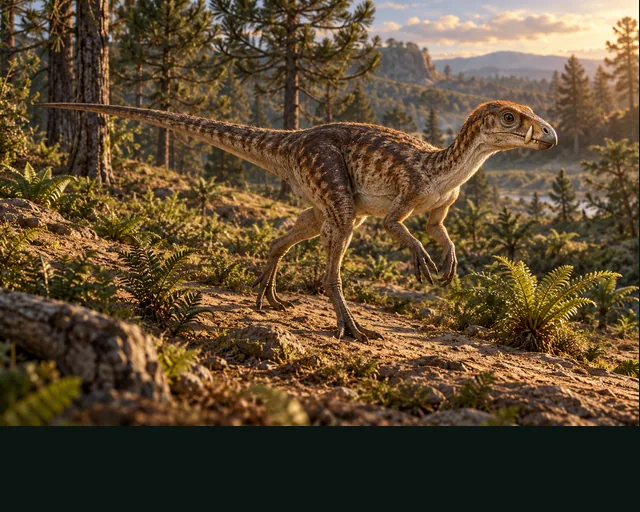
Our picture follows a complete restoration specifically identified as Echinodon becklesii by Nobu Tamura. It retains the short head, small two-legged body, short forelimbs and long tail. It is not generated from an isolated jaw image or a relabelled relative.
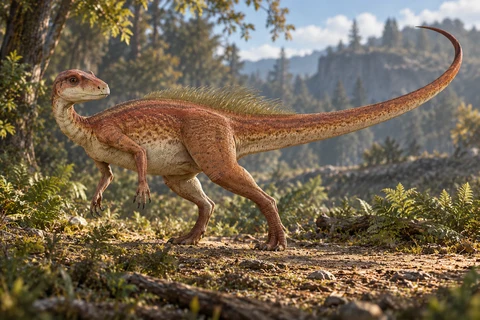
The completed postcranial body, skin, colours and woodland setting remain artistic interpretations. The closed mouth does not show every diagnostic tooth, and the image does not establish preserved armour or bristles. It offers a friendly introduction while the text explains why the unusual jaw anatomy matters.
Compare Heterodontosaurus and Abrictosaurus, then browse the E directory.
Quick answers
- Where is Echinodon known from?
- The Purbeck record of southern England.
- What kind of dinosaur was it?
- The reviewed study identifies it as a small heterodontosaurid.
- Do canine-like teeth prove meat-eating?
- No. Tooth form and wear must be considered together, and the study supports a mainly plant-eating interpretation for the group.
- Is its complete body known?
- The principal evidence is jaw material; the full-body illustration is an artistic reconstruction.