Jurassic Dinos editorial · Updated · Source-based review
What was Abrictosaurus?
Abrictosaurus was a small dinosaur from the Early Jurassic of southern Africa. It belonged to the heterodontosaurids, a group whose name refers to having different kinds of teeth. Its story shows why a tiny tooth can matter more to classification than a dramatic-looking illustration.
Where does the evidence come from?
The main specimen, NHMUK RU B54, comes from the Upper Elliot Formation near Nosi in Lesotho. It includes part of the skull and much of the skeleton, with important gaps. In his 2012 review, Paul Sereno did not accept all additional material historically associated with the specimen as securely belonging to Abrictosaurus.
This matters because combining two unrelated fossils can create a misleading description. Researchers must first establish which bones belong together and which can confidently be assigned to the same kind of animal. A museum catalogue number is therefore more than a label: it helps readers track the exact evidence behind a claim.
Did it have big tusks?
Unlike the conspicuous fang-like teeth of some relatives, the reviewed Abrictosaurus specimen lacks strongly enlarged caniniform teeth. “Caniniform” means shaped rather like a canine tooth. Smaller teeth in corresponding positions may represent reduced versions of them. It would be misleading to draw giant tusks simply because a relative possessed them.
The cheek teeth also carry wear surfaces. Those are areas altered as opposing teeth contacted each other, providing clues to how the jaw worked. Fossil teeth can reveal mechanical activity without preserving the animal’s final meal.
How big was it, and what did it eat?
A 2012 study of the related Fruitadens discussed the Abrictosaurus specimen as roughly 75–80 centimetres long, while noting uncertainty about its growth stage. That is not a secure maximum adult size. We avoid converting a measurement of one incompletely understood individual into a rule for the whole species.
Plant eating is the usual interpretation for these small heterodontosaurids, although a precise menu is not established for this individual. The important point is how teeth and jaw structure support a feeding interpretation, rather than how friendly or fierce an illustration looks.
Are the filaments in the picture certain?
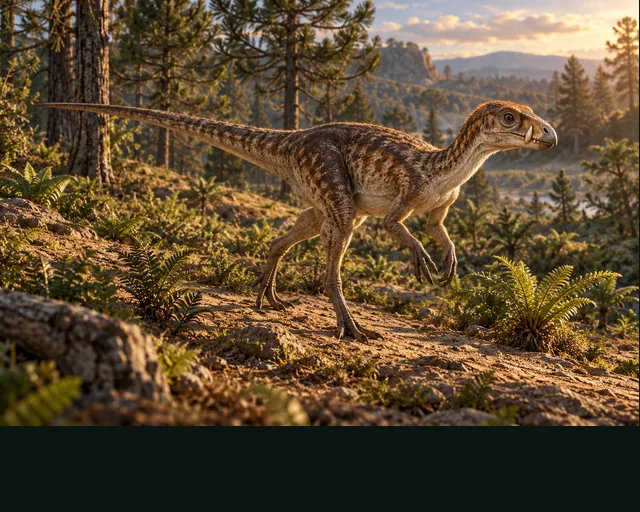
No. Our AI illustration follows the complete restoration credited to LadyofHats, with later file-history contributions from IJReid. The slender body, small forelimbs and long tail follow that visual reference. Its filament-like covering and colours remain artistic choices, not a preserved coat from this specimen.
Explore Heterodontosaurus, Massospondylus, or the A–Z directory.
Quick answers
- Where was Abrictosaurus found?
- The defining specimen comes from the Upper Elliot Formation near Nosi in Lesotho.
- Did Abrictosaurus have large tusks?
- The reviewed specimen lacks strongly enlarged caniniform teeth; some smaller teeth may be reduced counterparts.
- How big was Abrictosaurus?
- One study estimated the specimen at about 75–80 cm long, but its growth stage is uncertain, so this is not a secure adult maximum.
- Are its illustrated filaments proven?
- No. The covering in this artwork follows a credited restoration and is not a preserved coat from the defining fossil.