Jurassic Dinos editorial · Updated · Source-based review
What was Magnapaulia?
Magnapaulia laticaudus was a plant-eating lambeosaurine hadrosaurid from Late Cretaceous Baja California in northwestern Mexico. Hadrosaurids are often called duck-billed dinosaurs. A 2012 revision examined this animal’s anatomy and relationships, establishing Magnapaulia as its genus rather than retaining the earlier tentative assignment to Lambeosaurus.
Why does the tail attract attention?
The revised diagnosis highlights unusually elongated structures associated with the vertebrae. These include tall neural spines above parts of the backbone and long haemal arches beneath the front of the tail. Neural spines are projections of vertebrae, not exposed spikes sticking through the skin. Haemal arches are bones associated with the tail’s underside.
These distinctions help explain why a scientific description and a living outline answer different questions. The study uses a combination of characters to identify the animal. A deep-bodied reconstruction makes some proportions easier to visualise, but it cannot independently establish swimming ability, a particular gait or the precise shape of all the surrounding soft tissue.
Do we know anything about its skin?
Yes. The paper describes patches containing impressions and natural casts of scales. The surfaces form a mosaic of polygonal to oval structures, with some larger elements among the smaller ones. These are valuable examples of evidence beyond bones.
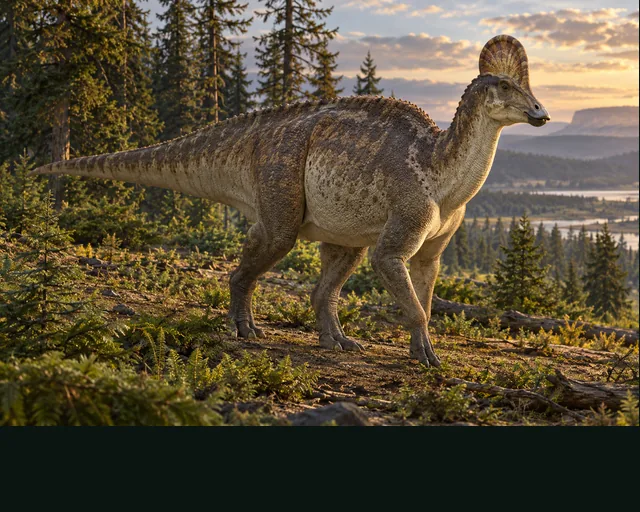
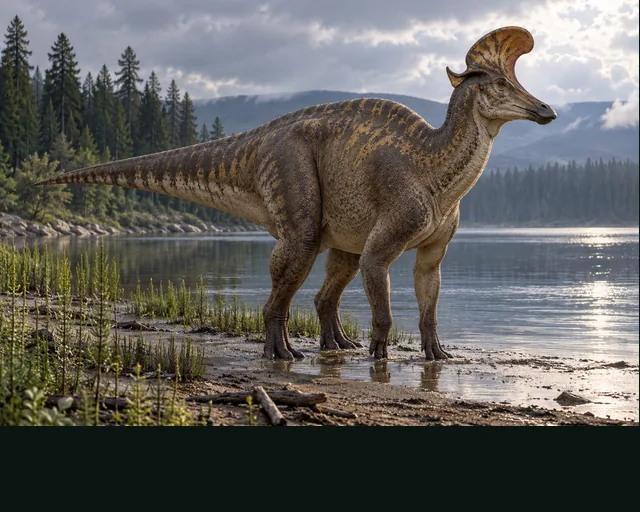
Nevertheless, a patch is not a complete skin map. It does not show every region of the animal or establish the pigments responsible for an overall colour pattern. The continuous row of small dorsal scales and the warm markings in our illustration therefore remain elements of the approved source artist’s reconstruction, rather than direct readings of those fossil patches.
What did the relationship study suggest?
The analysis linked Magnapaulia with Velafrons as southern North American lambeosaurines. That result contributed to questions about geographical differences within the group. It is an evolutionary interpretation from compared anatomy, not a claim that modern national borders separated dinosaur populations in the same way they separate countries today.
Our whole-animal image follows a specifically named complete restoration. Its crest outline, throat details and scenic setting retain artistic uncertainty. Compare Lambeosaurus and Corythosaurus as separate documented accounts, then continue through the M directory.
Quick answers
- Where did Magnapaulia live?
- Baja California in northwestern Mexico.
- What kind of dinosaur was it?
- A lambeosaurine hadrosaurid, or duck-billed dinosaur.
- Is any skin texture known?
- Yes. Patches of scale casts and impressions are described.
- Do those patches prove the entire pictured pattern?
- No. They do not reveal the whole body’s colours or every surface feature.