Jurassic Dinos editorial · Updated · Source-based review
What was Macrocollum?
Macrocollum itaquii was an early sauropodomorph dinosaur from Late Triassic Brazil. It lived during the early Norian, long before the best-known giant sauropods. The exceptionally preserved fossils described in 2018 helped researchers investigate both the emergence of a notably long neck and possible group behaviour among these earlier relatives.
Why did the long neck matter?
The study compared changes among dinosaurs from dated Brazilian rock sequences. Macrocollum helped document a stage when an elongated neck had become an important part of the sauropodomorph body plan. The authors suggested that reaching higher vegetation was a useful capability associated with this development.
A longer neck can extend reach without moving the entire body to every nearby mouthful. However, that broad functional interpretation does not identify a particular favourite plant or demonstrate one habitual neck angle. Nor does it mean that every earlier dinosaur had exactly the same short neck or that every later sauropodomorph used its neck identically.
What can several skeletons together suggest?
The describing researchers interpreted the clustered preservation of complete skeletons as evidence of gregarious behaviour. Gregarious means associating in groups. That makes the fossils relevant to behaviour as well as anatomy, because their positions and preservation provide information beyond the shape of an individual bone.
There are still limits. A fossil association does not reveal a group’s full membership, communication system or social hierarchy. It also does not establish that every individual spent every day in a herd. The proposed group-living interpretation should therefore be separated from a detailed imagined scene of family life.
How does our illustration represent it?
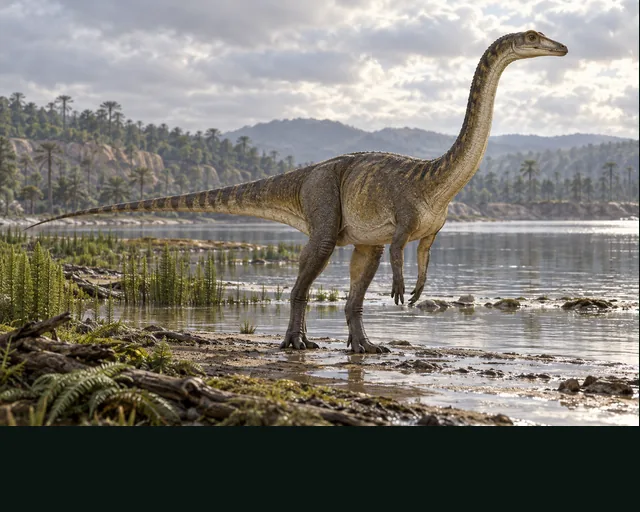
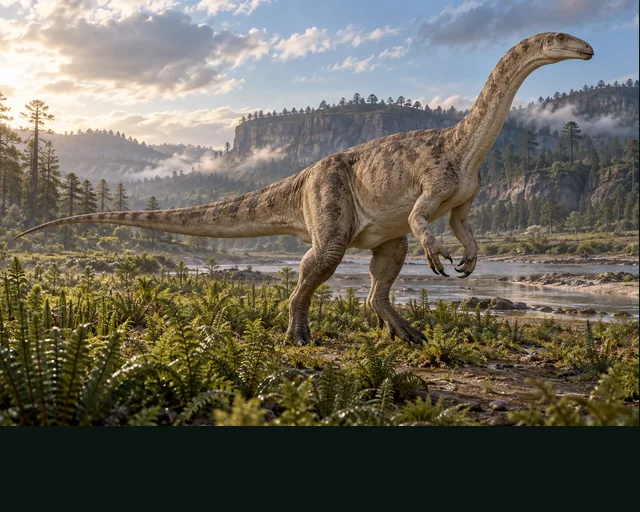
The approved complete living reference shows a small head on a long neck, a relatively slim trunk, short clawed arms, strong hindlegs and a long balancing tail. Our new artwork follows that named restoration. It does not substitute the pillar-legged proportions of a giant later sauropod. The particular colours, skin texture and standing pose remain artistic choices.
Only one animal appears in the scene, so the picture neither demonstrates nor disproves group living. Compare Plateosaurus and Massospondylus for other sauropodomorph accounts, then browse the M directory. Ask how anatomy, the arrangement of fossils and the age of the rocks each contribute different evidence to the evolutionary story.
Quick answers
- Where did Macrocollum live?
- The region now known as Brazil.
- Was it a giant pillar-legged sauropod?
- No. It was an earlier sauropodomorph.
- What is gregarious behaviour?
- Living or associating in groups.
- Does a fossil cluster reveal every detail of social life?
- No. It does not establish a complete social system.