Jurassic Dinos editorial · Updated · Source-based review
What was Machairoceratops?
Machairoceratops cronusi was a horned dinosaur from southern Utah, described in 2016. Its fossils came from the upper member of the Wahweap Formation within Grand Staircase–Escalante National Monument. The study identified it as an early-branching centrosaurine, part of one of the major horned-dinosaur lineages.
Which parts were actually discovered?
The specimen, UMNH VP20550, represents cranial material from one individual. It includes brow horncores, parts of the cheek and skull roof, a braincase and much of the frill. These are not a complete skeleton with a preserved skin-covered body. The fossils are held by the Natural History Museum of Utah.
A horncore is the bony support inside a horn, so its preserved surface does not necessarily show every detail of the living outer covering. Likewise, a braincase is the bony region surrounding the brain; finding one does not mean that a soft brain itself has survived.
Why are the frill ornaments distinctive?
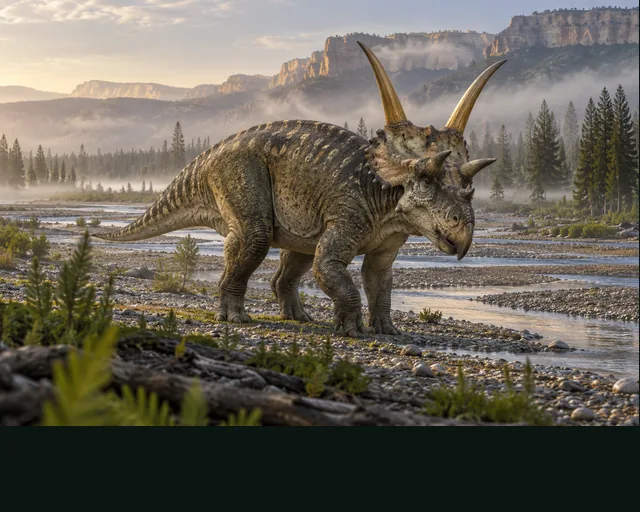
Two elongate ornaments curve forward and upward from the rear of the frill. The original description highlights grooves running along them. Their position and form help distinguish Machairoceratops from other horned dinosaurs, including Diabloceratops from a lower part of the same formation.
The describing team used two approaches to investigate relationships. Both supported an early-branching centrosaurine identity, but they differed in how precisely they resolved its nearest relationships. This agreement and disagreement can coexist: confidence in a broader group does not require every smaller branch of the tree to be equally certain.
Why is the whole animal still an interpretation?
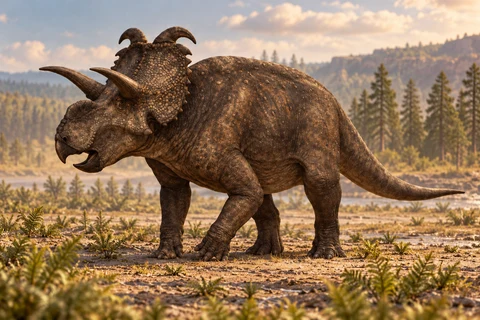
Our picture follows an approved complete living restoration specifically labelled Machairoceratops. The bent frill horns, beak and four-legged body make its subject recognisable. However, the fine body bristles shown by that artist are not established by the reviewed skull specimen. Colour, skin coverings and the woodland pose also remain artistic choices.
Keeping that distinction visible lets a realistic image introduce the animal without disguising the gaps in the fossil record. Compare Diabloceratops and Albertaceratops, then continue through the M directory. Look at where each ornament grows before deciding that two similarly curved horns are equivalent structures.
Quick answers
- Where were the fossils discovered?
- The Wahweap Formation of southern Utah.
- Was a complete body found with the skull?
- The reviewed specimen consists of cranial material.
- Where are the distinctive curved ornaments?
- On the back of the skull frill.
- Are the illustrated body bristles proven by this specimen?
- No. They come from the source artist’s reconstruction.