Jurassic Dinos editorial · Updated · Source-based review
What makes Albertaceratops stand out?
Albertaceratops was a large plant-eating ceratopsian with long horns above its eyes. Its most important defining specimen is an almost complete skull from the lower Oldman Formation of southern Alberta, Canada. Michael Ryan described Albertaceratops nesmoi in 2007.
Long brow horns might remind you of Triceratops, but appearance alone can mislead. Ryan’s analysis placed Albertaceratops within Centrosaurinae, a different ceratopsid branch from Triceratops. Its skull showed that prominent brow horns were not limited to the branch many readers associate with them.
How do scientists use the skull to identify it?
A ceratopsian skull provides many comparison points: the snout, cheek region, bones surrounding the eye, and the frill at the back. Researchers examine combinations of features across these regions. One long horn is not a complete diagnosis.
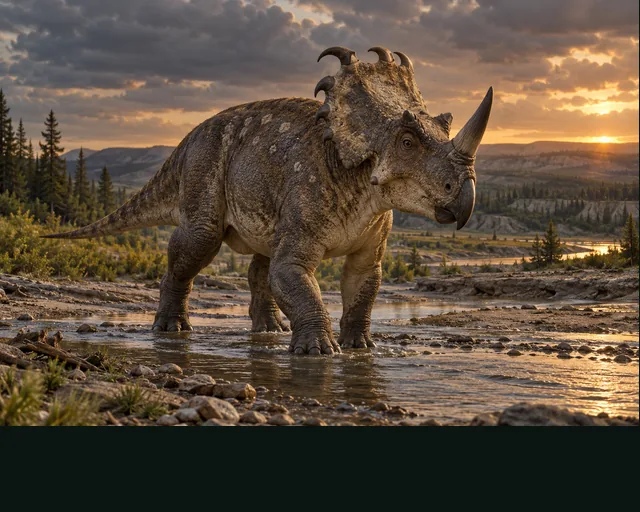
The Natural History Museum’s restoration shows paired brow horns and curved ornaments near the top of the frill. Our artwork follows that complete museum reference. The bony horn cores and the living soft-tissue covering are different things, however, and the finished colour pattern is an artistic choice.
Why should we be careful with older locality lists?
Some early accounts associated material from Montana’s Mansfield bonebed with Albertaceratops. The history became more complicated when researchers studied and named Medusaceratops and later reassessed the bonebed material. We do not treat every old Montana referral as if it were part of the defining Albertaceratops skull.
This is a useful distinction between a holotype and referred specimens. The holotype anchors the name. Other fossils can be assigned to the same taxon, but those assignments must remain testable. More complete material can reveal that a previous grouping mixed different animals or used the wrong identification.
How large was it, and what did it eat?
The museum directory gives an approximate length of seven metres. That is an estimate for a reconstructed animal, not a tape measurement of a complete living individual. We retain the attribution in the text and leave a precisely supported size-comparison value unset.
Albertaceratops was herbivorous. Its beak and chewing apparatus belonged to a plant eater, but the reviewed sources do not establish a precise plant menu or prove a particular daily feeding routine.
Were its horns weapons or signals?
Both ideas raise interesting research questions for ceratopsians. The reviewed evidence here does not show how this individual used its horns, so the calm portrait does not stage a supposedly documented battle.
Compare Centrosaurus and Triceratops, or browse the A–Z directory under A.
Quick answers
- Was Albertaceratops a relative of Triceratops?
- Both were ceratopsids, but Albertaceratops belongs to Centrosaurinae, a different branch from Triceratops.
- What is its defining specimen?
- Ryan's 2007 description was based on an almost complete skull from southern Alberta's lower Oldman Formation.
- How long was it?
- The Natural History Museum estimates about seven metres; this is not a measurement of a complete living individual.
- Are all old Montana referrals securely Albertaceratops?
- No. The history of the Mansfield material includes subsequent Medusaceratops research and needs individual checking.