Jurassic Dinos editorial · Updated · Source-based review
What was Lokiceratops?
Lokiceratops rangiformis was a plant-eating horned dinosaur from Late Cretaceous Montana. Described in 2024, it belonged to the centrosaurine branch of ceratopsids. Its fossils came from the lower McClelland Ferry Member of the Judith River Formation, close to the modern United States–Canada border.
Which horns make it distinctive?
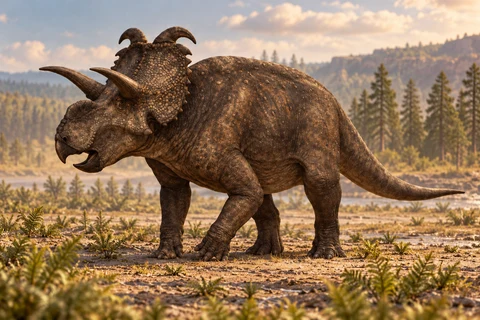
Two enormous, flattened ornaments curve outward from the upper frill. They are not extra horns growing from the nose. The original study also describes conspicuous, unequal ornaments nearer the frill’s centre and finds no definitive evidence of a nasal horn. This combination differs from the familiar three-horn arrangement many readers associate with Triceratops.
The genus name invokes Loki, the Norse mythological figure, and a horned face. The reference to caribou in the species name reflects the uneven ornamentation. Neither part of the name means that the animal wore a helmet or possessed supernatural abilities; both are human ways of describing a striking fossil discovery.
What kind of world did it inhabit?
The Natural History Museum of Utah describes swamps and floodplains along eastern Laramidia, the western landmass separated from eastern North America by a great seaway. Today’s Montana landscape is therefore not a direct guide to the animal’s climate or surroundings. Mountains, shorelines and ecosystems have changed substantially since then.
Why did one more horned dinosaur matter?
The study examined an unusually diverse regional horned-dinosaur assemblage. Its analysis linked Lokiceratops with Albertaceratops and Medusaceratops and explored whether related lineages evolved within geographically restricted areas. This makes the discovery a question about biodiversity as well as spectacular horns.
There are limits to that interpretation. A dinosaur known from a small fossil-bearing area did not necessarily stop at the edge of the exposed rocks. Unequal preservation and sampling can hide parts of its former range, while the function of elaborate ornaments remains something to investigate rather than a directly observed behaviour.
What does our image interpret?
The illustration follows the approved named whole-animal restoration, including its distinctive frill and lack of a nasal horn. Skin colour, horn coverings and the pose remain artistic. Compare Albertaceratops and Triceratops as separate accounts, then browse the L directory. These links compare horned dinosaurs without implying that all three shared the same place and time.
Quick answers
- Where did Lokiceratops live?
- In the region now represented by northern Montana.
- What were the huge blade-like structures?
- Enlarged ornaments on the skull frill.
- Did it have a Triceratops-like nasal horn?
- The reviewed paper found no definitive evidence for a nasal horn.
- Do regional fossil sites reveal the exact limits of its range?
- No. Preserved fossil distributions can underestimate living ranges.