Jurassic Dinos editorial · Updated · Source-based review
What was Liliensternus?
Liliensternus liliensterni was a meat-eating dinosaur from Late Triassic Europe, with fossils known from Germany. It belonged among the early neotheropods, a major branch of theropod dinosaurs. Its long-legged appearance makes it an appealing predator to picture, but the growth stage of the fossils deserves just as much attention as the finished silhouette.
Were the known individuals fully grown?
A 2019 study discussing large early theropods identifies Liliensternus as represented by partial, skeletally immature specimens. Immature means that an individual had not yet completed its skeletal development. It does not mean that every available bone belonged to a tiny hatchling.
This distinction matters when someone asks for the animal’s maximum length. The dimensions of one growing individual cannot automatically establish the largest adult size of its species. Equally, being immature does not justify enlarging it to any impressive size we choose. A careful estimate needs a stated method and appropriate evidence, rather than simply stretching an illustration.
Why can growth affect evolutionary comparisons?
Some anatomical features change as an animal develops. Comparing a young individual with adults of other species can therefore mix differences caused by growth with differences caused by evolutionary history. The 2019 discussion also notes disagreement between analyses about relationships among several early neotheropods.
That uncertainty is useful information. Liliensternus helps us explore early predatory-dinosaur diversity, while reminding us that a family tree depends on the specimens and characters included. A familiar name in a children’s book is not a guarantee that every detail of its placement has been resolved.
How should you view our restoration?
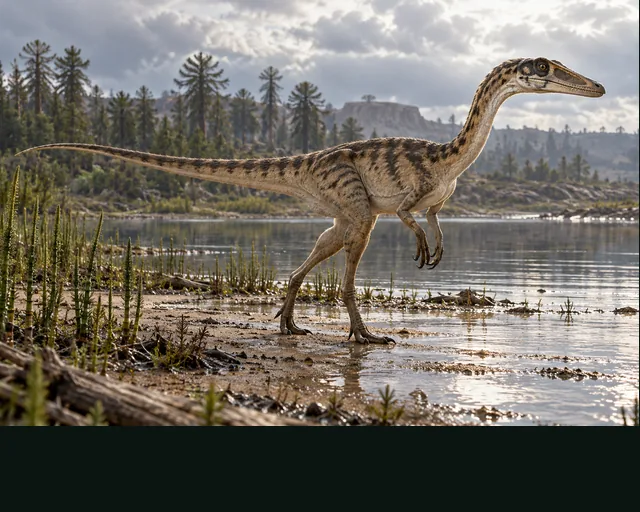
The image follows an approved complete living restoration specifically labelled Liliensternus. Notice the narrow head, long neck, grasping hands, strong hindlegs and long tapering tail. The small paired head crests belong to that source artwork’s interpretation; this page does not establish their presence as a confirmed fossil feature. Colours, skin details and the riverside pose are also artistic.
Compare Coelophysis and Dilophosaurus as separate early-theropod accounts. Continue through the L directory. Try distinguishing three questions as you browse: what was preserved, how mature was the individual, and which parts of its living appearance were reconstructed?
Quick answers
- When did Liliensternus live?
- The Late Triassic.
- Was it a meat-eater?
- Yes. It was an early predatory theropod.
- Do the studied fossils necessarily show maximum adult size?
- No. The reviewed research identifies immature specimens.
- Are the pictured head crests established here from fossils?
- No. They are retained as uncertain features of the named source artwork.