Jurassic Dinos editorial · Updated · Source-based review
What was Leonerasaurus?
Leonerasaurus taquetrensis was a small sauropodomorph from the Las Leoneras Formation of central Patagonia, Argentina. Its rock unit is generally regarded as probably Early Jurassic. Diego Pol, Alberto Garrido and Ignacio Cerda named it in 2011. It belongs in the story of sauropod origins without being a miniature version of every later giant.
What is a sacrum?
Your backbone contains separate regions with different jobs. In dinosaurs, the sacrum is the section linked to the pelvis, the bony framework around the hips. The Leonerasaurus description reports four sacral vertebrae. This arrangement was striking because it resembled that of larger early sauropods, even though the new animal remained small and retained several more ancestral features.
Simply counting these vertebrae is not a method for estimating body weight. Nor does the count mean that its whole spine was fused into one solid rod. It identifies a particular part of the skeleton that can be compared with the equivalent region in other animals.
Why did that combination matter?
The original analysis placed Leonerasaurus close to Sauropoda, outside the group itself. The authors also considered alternative relationships. Across those interpretations, the four-vertebra sacrum did not require an enormous body. Its appearance could therefore be separated from the later increase in size associated with giant sauropods.
This is a useful example of mosaic evolution: different features can change at different times. It does not establish that Leonerasaurus was the direct ancestor of a familiar giant. An evolutionary analysis proposes relationships from combinations of evidence, rather than arranging every fossil into a simple ladder from small to large.
What else can you look for?
The description also highlights low, spoon-shaped crowns on the front teeth. A tooth crown is the exposed working part of a tooth. Such details contribute to anatomical comparisons, but they do not reveal a complete list of plants eaten throughout the animal’s lifetime.
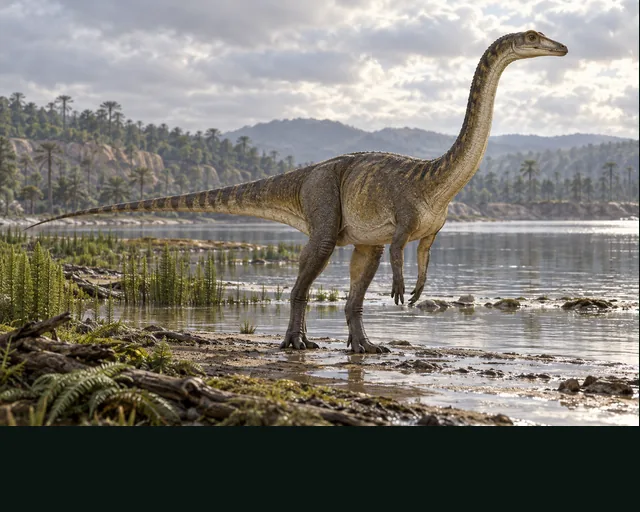
Our illustration follows the approved named complete restoration. Its small head, rising neck, short arms, strong hindlegs and long tail provide a visual introduction; skin patterns and the precise stance remain artistic. Compare Plateosaurus and Massospondylus, then browse the L directory.
Quick answers
- Where did Leonerasaurus come from?
- The Las Leoneras Formation of central Patagonia, Argentina.
- What is the sacrum?
- The section of the backbone connected to the pelvis.
- How many sacral vertebrae were reported?
- Four.
- Does a sauropod-like sacrum automatically mean a giant animal?
- No. Leonerasaurus was small compared with giant sauropods.