Jurassic Dinos editorial · Updated · Source-based review
What was Ledumahadi?
Ledumahadi mafube was a very large plant-eating sauropodomorph from Early Jurassic South Africa. Its name draws on Sesotho words referring to a giant thunderclap and dawn. The fossils were described in 2018 from the upper Elliot Formation of the Free State, near the border with Lesotho.
Why are its legs so interesting?
Many familiar giant sauropods carried their weight on relatively straight, column-like limbs. Ledumahadi offers a different combination: substantial size and habitual four-legged support, but without that fully developed columnar stance. The describing researchers interpreted its limbs as partly bent.
Think of the difference between using four supports and arranging those supports in a particular way. Those are related engineering questions, but they are not identical. In evolutionary terms, changing the number of limbs regularly bearing weight need not coincide with every later change in limb structure. The study placed Ledumahadi outside Sauropoda, within the wider sauropodomorph group.
Was the fossil a young giant?
The researchers examined the microscopic structure of bone, an approach called histology. Growth marks and changes in the tissue supported their interpretation that the studied individual was an adult nearing its maximum size. That is evidence about this specimen, rather than a guarantee that every member of the species reached exactly the same size or died at the same age.
The named type specimen is incomplete and consists of bones from behind the head. Its importance therefore does not depend on a complete mounted skeleton. Preserved details can support questions about growth, relationships and support even when other parts are absent.
What does the living picture add?
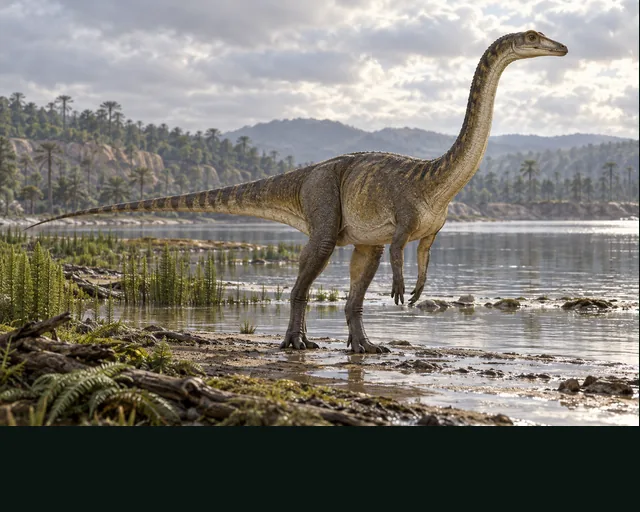
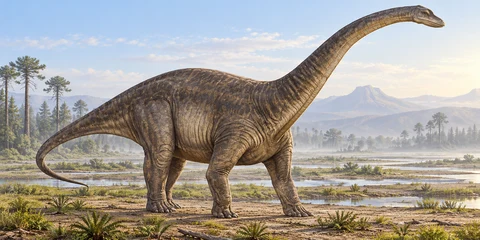
Our image follows an approved complete restoration explicitly identified as Ledumahadi. Its sturdy, bent limbs and rounded trunk are the visual starting point; no fossil photograph was used to invent a missing whole-animal shape. The colours, skin details and dawn floodplain remain artistic choices, and the picture is not an independent test of the posture analysis.
Compare Massospondylus and Barapasaurus for other parts of sauropodomorph history. Continue through the L directory. Together, these accounts invite a useful question: which features evolved together, and which appeared in separate steps?
Quick answers
- Where was Ledumahadi discovered?
- The upper Elliot Formation in South Africa’s Free State.
- Did it stand on four limbs?
- The study inferred habitual four-legged support.
- Were its legs the same as later columnar sauropod legs?
- No. Researchers inferred partially flexed limbs.
- How did researchers assess maturity?
- They examined growth patterns in bone tissue.