Jurassic Dinos editorial · Updated · Source-based review
What was Lanzhousaurus?
Lanzhousaurus magnidens was a plant-eating iguanodontian dinosaur from Early Cretaceous rocks in Gansu, China. Its fossils come from the Hekou Group. The most memorable feature is its unusually large teeth, but the interesting story concerns how those teeth grew and how they fitted into an evolving feeding system.
How did its mouth differ from a duck-billed dinosaur’s?
The 2017 tooth study describes relatively few, very large teeth in Lanzhousaurus. Hadrosauriform relatives instead developed batteries containing many smaller teeth. A dental battery is a closely packed arrangement in which numerous teeth contribute to a working chewing surface; it does not mean an electrical battery inside the jaw.
These arrangements offer different ways of keeping a plant-processing mouth useful. Counting teeth alone would miss the difference in their individual size and arrangement. Likewise, seeing a large tooth does not identify a particular tree, prove that the animal preferred tough branches or reveal an exact menu.
How can scientists investigate tooth growth?
Researchers used CT scanning and stable-isotope analysis. A CT scan lets researchers examine internal structure without simply cutting an object apart. Stable isotopes are forms of an element that can leave measurable chemical patterns in growing tissue. Interpreting those patterns provides a way to investigate how the tooth’s hard enamel covering elongated.
The authors inferred rapid enamel growth and argued that this capacity appeared before hadrosaurids evolved. In that interpretation, a useful feature of tooth production was later incorporated into a different, more elaborate feeding arrangement. Evolution can change the organisation of a system while retaining some older capabilities.
What does our reconstruction show?
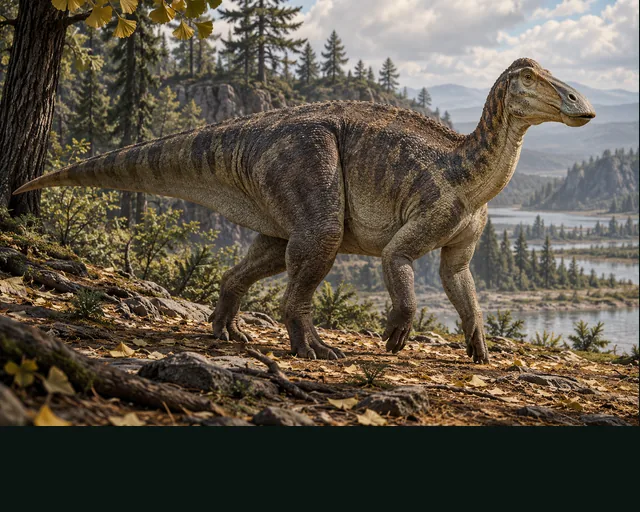
The whole-animal illustration follows the approved, explicitly named Lanzhousaurus restoration. Notice the long tail, substantial hindlegs, shorter forelimbs and beaked head. The new skin pattern and atmospheric setting are artistic choices. The teeth inside the mouth are not all directly visible, and the exterior picture cannot demonstrate a growth rate.
Compare Iguanodon and Edmontosaurus to explore other separately documented ornithopods. The L directory provides another route onward. Keep asking which evidence supports each claim: a complete restoration helps visual recognition, while the tooth study addresses growth and feeding evolution.
Quick answers
- Where did Lanzhousaurus live?
- Its fossils come from the Hekou Group of Gansu, China.
- What makes its teeth interesting?
- It combined relatively few teeth with unusually large individual teeth.
- What is enamel?
- The hard outer covering of a tooth.
- Does a tooth-growth study identify every plant it ate?
- No. Growth evidence and exact meal identification answer different questions.