Jurassic Dinos editorial · Updated · Source-based review
What was Kamuysaurus?
Kamuysaurus was a duck-billed dinosaur from Late Cretaceous Hokkaido, Japan. A substantial skeleton makes it especially informative in a region where many dinosaur discoveries are fragmentary. Its bones were buried in marine deposits, creating an opportunity to distinguish where an animal lived from where its remains ended up.
What makes the fossil distinctive?
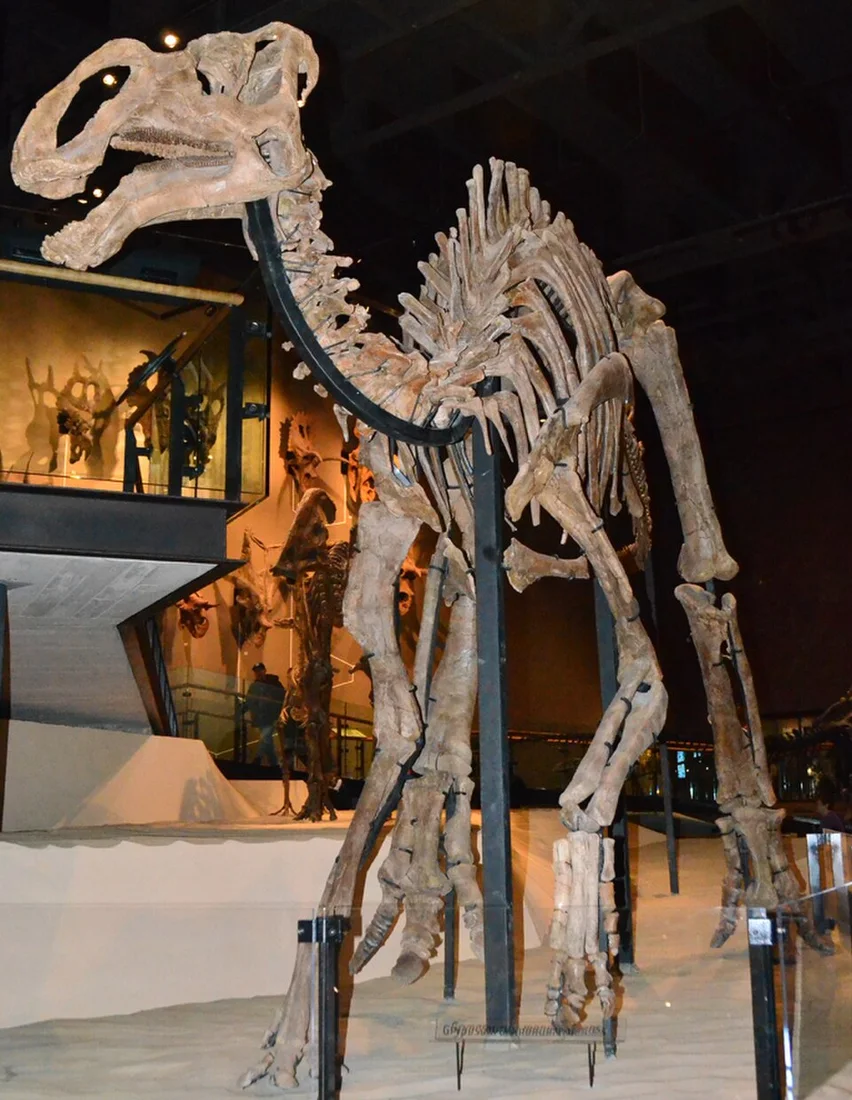
The specimen preserves much of the skeleton and parts of the skull, allowing scientists to compare more than a single tooth or jaw fragment. Distinctive details in the jaw and other bones helped identify it as a separate genus. Like other hadrosaurs, it had specialised teeth for processing vegetation; the duck-billed nickname describes a broad resemblance, not a relationship with ducks.
Where was it found and how was it named?
A tail fossil was noticed in 2003 near Mukawa. Larger excavations followed in 2013 and 2014, and the animal was formally named in 2019. Its earlier nickname, Mukawaryu, referred to the locality. Kamuysaurus incorporates the Ainu word kamuy, while japonicus refers to Japan. The fossil is associated with the Hakobuchi Formation.
What can we infer, and what remains uncertain?
A carcass carried into the sea can be buried among marine sediments even when the living animal fed on land. The skeleton therefore cannot be used as proof of a seagoing hadrosaur. Its relationship with other saurolophine hadrosaurs helps researchers investigate diversity and distribution around the northern Pacific. Size estimates based on limb bones are useful, but their assumptions should be kept separate from the directly preserved measurements.
Why is this Japanese dinosaur scientifically useful?
Its relatively extensive skeleton provides many anatomical comparisons. That makes it more informative about relationships and body structure than an isolated bone would be.
How can you check the evidence?
The Paleobiology Database record catalogues Kamuysaurus under Hadrosaurinae. Its linked bibliography identifies this research starting point: Y. Kobayashi, T. Nishimura, and R. Takasaki, K. Chiba, A. R. Fiorillo, K. Tanaka, T. Chinzorig, T. Sato, K. Sakurai. 2019. A new hadrosaurine (Dinosauria: Hadrosauridae) from the marine deposits of the Late Cretaceous Hakobuchi Formation, Yezo Group, Japan. Scientific Reports 9:12389. Open the bibliographic record. A catalogue entry establishes the source trail; it does not independently verify every later illustration or behavioural claim.
Use the dated genus overview to follow the references behind the discovery and anatomy discussed above. When sources disagree, compare which specimen and rock layer each author studied. A reconstructed whole animal can combine original bones with comparisons to relatives; those two kinds of evidence should not be confused. The account above explains the particular limits that matter for Kamuysaurus, rather than supplying unsupported size, speed or lifespan figures.
Read the image and keep exploring
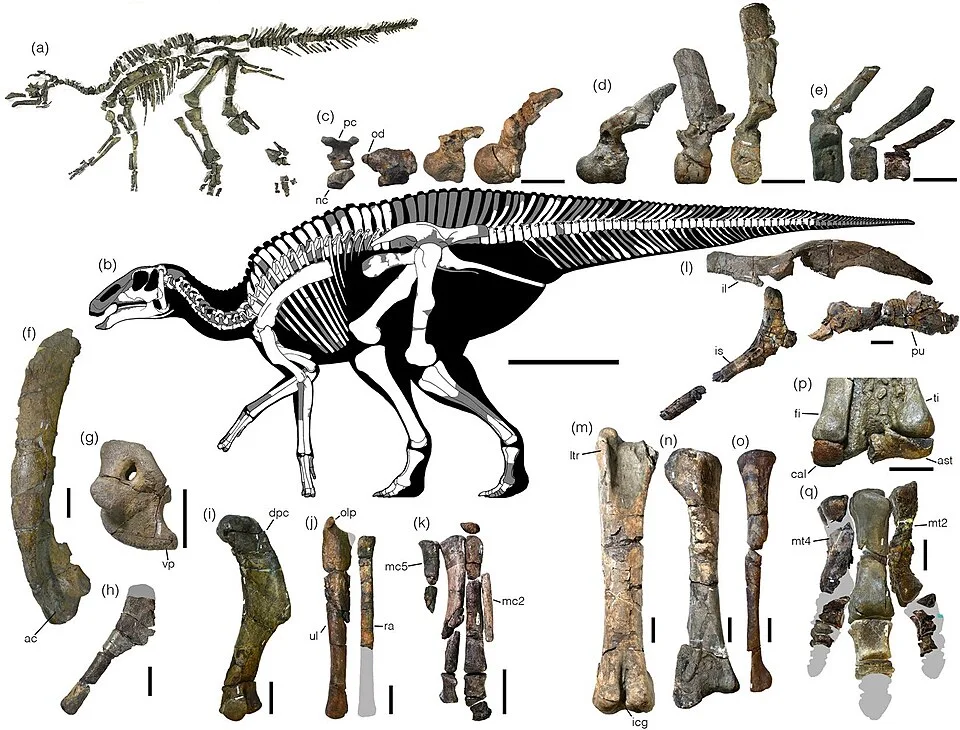
The published skeletal diagram maps preserved Kamuysaurus elements onto a reconstructed body, separating surviving bones from missing regions. This diagram explains the stated evidence; schematic elements are not additional fossil observations.
Compare Edmontosaurus, Shantungosaurus, Gryposaurus. Find more names in the K index and explore ornithischian field notes. The glossary explains unfamiliar fossil terms.
Quick answers
- Where have Kamuysaurus fossils been found?
- The discoveries discussed here come from Japan. Modern place names describe discovery locations, not a complete ancient geographic range.
- When did Kamuysaurus live?
- It is placed in the Cretaceous period. See the discovery discussion for qualifications about the particular rock layers and dating.
- Where can I compare Kamuysaurus with related dinosaurs?
- Follow the related field notes below. Comparisons explain shared anatomy; they do not imply that all the animals lived together.