Jurassic Dinos editorial · Updated · Source-based review
What was Jeyawati?
Jeyawati rugoculus was a plant-eating hadrosauroid dinosaur from New Mexico. Its genus name means “grinding mouth” in the Zuni language. The name is memorable, but the scientific description identifies the animal through particular anatomical features, not simply through an evocative picture of it chewing.
What is the story behind the eye?
The 2010 description by Andrew McDonald, Douglas Wolfe and James Kirkland centres on MSM P4166 from the Moreno Hill Formation. Among its diagnostic features are a rough outer surface and a notable opening in the postorbital, a bone behind the eye opening. The authors assessed the individual as a subadult or adult.
“Rough bone” and “wrinkled skin” are different claims. A bony surface can help researchers recognise a fossil without revealing every feature of the skin that once covered it. When you encounter a dramatic name or nickname, checking which tissue the description actually refers to is a useful habit.
Where does it fit among duck-billed relatives?
The original analysis placed Jeyawati among early-diverging hadrosauroids. That makes it relevant to the wider story of the familiar duck-billed dinosaurs, but it does not automatically make this particular genus the direct ancestor of every later duckbill.
A branching evolutionary tree compares patterns of shared features. It is not a parade in which one named animal simply transforms into the next. Read the accounts for Bactrosaurus and Edmontosaurus with that distinction in mind.
Why do rock ages need a separate source?
A 2021 study used zircon dating to distinguish depositional phases within the Moreno Hill Formation and revise earlier correlations. A formation is a package of rocks, not one instant in time. Dates concerning its deposition should not be copied into an animal profile as the exact first and last days that genus existed.
How was this living view made?
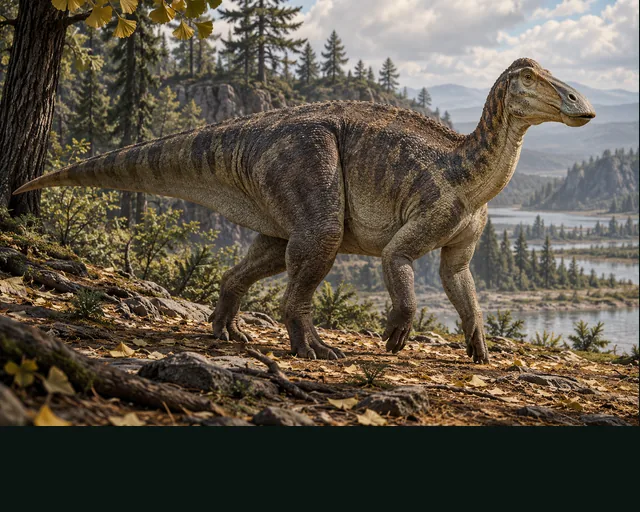
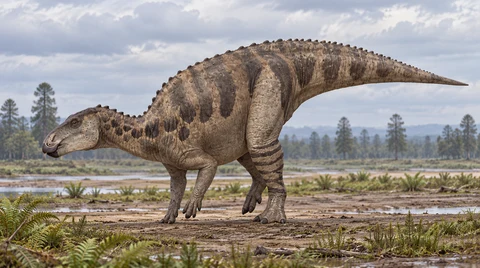
The reference is Nobu Tamura’s explicitly named, complete Jeyawati restoration. Our independent riverbank scene follows its low head, deep torso, four-limbed stance and long tail. Its green pattern and small dorsal ridge are features of the artistic interpretation, rather than extra fossil discoveries. Continue with more names beginning with J when you have finished comparing the evidence.
Quick answers
- What does Jeyawati mean?
- Grinding mouth, from the Zuni language.
- Where were its fossils found?
- The Moreno Hill Formation of New Mexico.
- What is the postorbital?
- A bone behind the eye opening.
- Does the name prove wrinkled eyelids?
- No. The described roughness is on bone.