Jurassic Dinos editorial · Updated · Source-based review
What was Jaxartosaurus?
Jaxartosaurus was a plant-eating hadrosaurid dinosaur from Late Cretaceous Kazakhstan. It is usually placed among the lambeosaurines, the duck-billed group familiar for head crests. Its name refers to the Jaxartes River, and the species listed by the Natural History Museum is aralensis.
How much of the dinosaur is actually known?
The museum account identifies a skull roof and braincase. Those are important parts of a head, but they are not an entire body or a complete external silhouette. The braincase is the bony region surrounding the brain; the skull roof forms the upper part of the skull.
Different fossil pieces answer different questions. A head bone can help researchers compare related dinosaurs, yet it does not automatically tell them the shape of every foot, the pattern on the skin or the full outline of a head crest. A source can confidently recognise a dinosaur group while leaving many details of the living animal uncertain.
Why does the illustration show a whole animal?
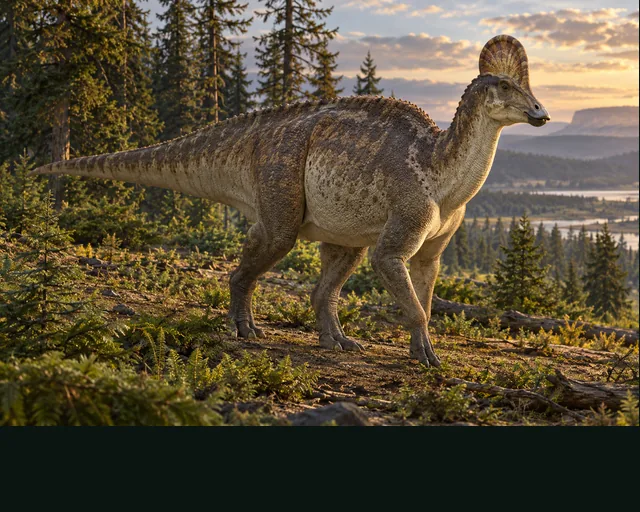
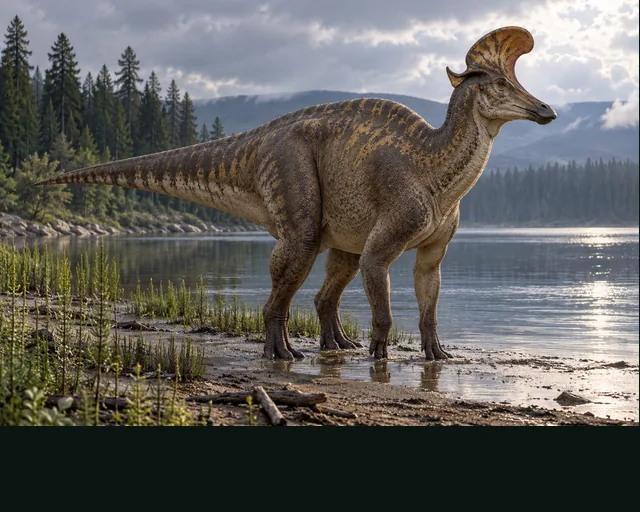
The credited museum restoration offers a complete artistic interpretation, which is the reference for our new scene. Notice its beaked head, raised crest, curved neck, deep torso and long tapering tail. Our version places that interpreted body in a separate riverbank landscape and changes the direction it faces.
Treat that complete view as an illustrated proposal rather than a photograph of the fossil discovery. The restored crest is particularly easy to overread because it is so noticeable. Its presence in the picture does not mean that the museum’s listed material preserves the entire outer crest, its colour or its function.
What makes a useful comparison?
Compare Corythosaurus and Lambeosaurus. For each account, ask which part of the head is documented and how the explanation distinguishes preserved material from restoration. Simply lining up three striking silhouettes would miss the evidence behind them.
You can also make a small observation list: what is explicitly reported from a fossil, what is inferred from a comparison and what was chosen by the illustrator? Keeping those questions separate lets you enjoy the complete animal without pretending that an incomplete find has become a complete one. Continue through names beginning with J when you are ready for another investigation.
Quick answers
- Where was Jaxartosaurus found?
- Kazakhstan.
- Was its entire body discovered?
- The museum account lists only a skull roof and braincase.
- What does its name recall?
- The Jaxartes River.
- Is the whole crest known from this picture?
- No. The complete external outline is restored.