Jurassic Dinos editorial · Updated · Source-based review
What was Iguanacolossus?
Iguanacolossus was a large plant-eating iguanodontian dinosaur from Early Cretaceous Utah. Its species is Iguanacolossus fortis. The name has an appropriately enormous sound, but the most useful starting point is a collection number: UMNH VP 20205, the incomplete individual on which the name is based.
Where does its fossil story begin?
The original 2010 description places the find at Don’s Ridge in the lower Yellow Cat Member of the Cedar Mountain Formation. The same paper introduces Hippodraco, a different dinosaur with a different reference specimen. Sharing a publication does not make their remains interchangeable.
Keep that in mind when reading a headline about “new thumb-spiked dinosaurs.” A headline may describe the topic of a whole study rather than every structure preserved in one named individual. Before assigning a claim to Iguanacolossus, follow it back to the correct specimen and paragraph.
What is a life restoration?
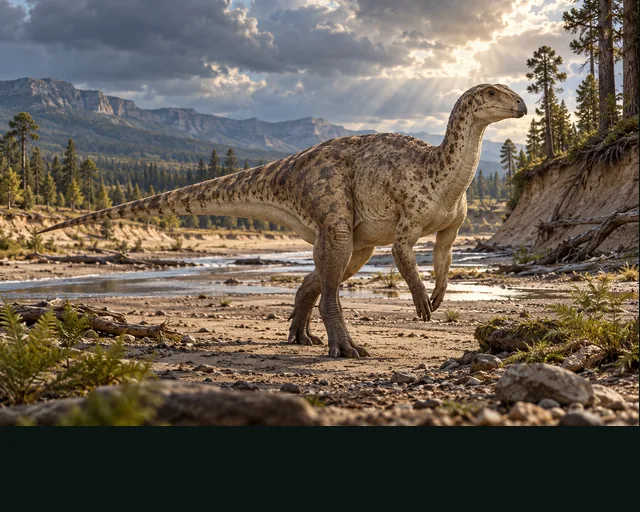
Lukas Panzarin’s complete Iguanacolossus illustration is the reference for our new artwork. It shows a deep torso, a low beaked head, substantial hindlegs, shorter forelimbs and a long, strong tail. The animal in our scene faces a different direction and stands beside a new river landscape, but those visible proportions guide its identity.
A life restoration is an artist’s view of the living animal. It can connect the isolated details in a technical description into an understandable whole, while still containing uncertain choices. The skin pattern is not a recovered photograph, and a relaxed stance does not tell us that the dinosaur was always gentle. Colour and mood are particularly easy to mistake for biological facts because they make an image feel convincing.
How can you compare it with other iguanodonts?
Try a two-column notebook. In one column, list features you actually see in each illustration. In the other, write the fossil or scientific source supporting a claim. This keeps an observation about artwork separate from a conclusion about anatomy. An empty second column is a reason to ask a question, rather than immediately fill in an answer.
Read about Iguanodon and Camptosaurus for two other accounts in this broad dinosaur group. Then explore names beginning with I to find the next animal you want to investigate.
Quick answers
- Where was Iguanacolossus found?
- At Don’s Ridge in Utah.
- Was it the same as Hippodraco?
- No; they have separate type specimens.
- Do we know its exact colour?
- No; the colour in the illustration is artistic.
- What is its main fossil reference?
- The partial individual numbered UMNH VP 20205.