Jurassic Dinos editorial · Updated · Source-based review
What was Hypselospinus?
Hypselospinus was a plant-eating ornithopod from Early Cretaceous England. Its species Hypselospinus fittoni concerns fossils from the Hastings area, within the wider Hastings Group record.
The animal was originally known as Iguanodon fittoni. That older label reflects a period when a variety of large European ornithopods were placed in Iguanodon, even though later comparisons showed that some were not especially close relatives of the best-established species.
Why were old collection records a problem?
Historical excavations and museum acquisitions did not always leave associations and provenance as clear as modern researchers would like. Bones collected in the same region could become difficult to connect with particular skeletons or geological horizons.
David Norman’s detailed study, published in the 2015 journal issue, revisited those records alongside the anatomy. Establishing which bones could be attributed to Hypselospinus was essential before drawing conclusions from the combined material.
What is a hypodigm?
A hypodigm is the set of specimens included in a taxon’s scientific description and interpretation. It may contain the type specimen and other referred material. If unrelated or uncertain bones enter that set, a reconstruction can accidentally combine features belonging to different animals.
Checking membership is therefore not just a paperwork exercise. It affects the diagnosis, body proportions and evolutionary analysis. A more impressive-looking composite skeleton is not necessarily a more accurate one.
How was it separated from Barilium?
The reviewed study addressed confusion between Hypselospinus fittoni and Barilium dawsoni, another dinosaur represented in the regional record. Detailed anatomical description helped distinguish the material attributable to each.
This does not mean that every former Iguanodon specimen should be relabelled Hypselospinus. Each transfer needs its own evidence. Keeping the species names and specimen associations explicit prevents a historical catch-all genus from being replaced by another equally confused collection.
What did its relationships suggest?
The analysis placed Hypselospinus among early styracosternan iguanodontians, relevant to investigating the wider evolutionary history of later duck-billed dinosaurs. That is a branching relationship, not a claim that this named species was the direct ancestor of every hadrosaur.
Reading the portrait
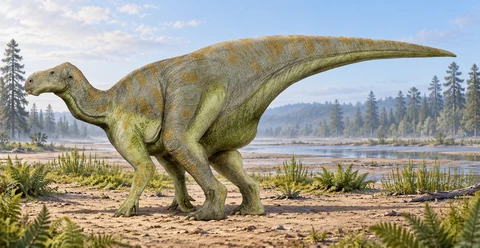
The approved complete reference guided the beaked head, curved neck, deep trunk, four limbs and long tapering tail. Its green colour, stripes and small dorsal scallops remain artistic interpretation.
The image is not an independent measurement source and does not establish an exact adult mass or a fully preserved skin outline. The text and source record explain which historical and anatomical evidence supports the account.
Compare Iguanodon and Barilium, then browse the H directory.
Quick answers
- What was its former name?
- The species was originally known as Iguanodon fittoni.
- Did all Iguanodon become Hypselospinus?
- No. This concerns a particular species and its attributable specimens.
- Why were museum records important?
- Old associations and provenance needed checking to decide which bones belonged in the account.
- Is the artwork a measurement source?
- No. Colours, stripes and soft-tissue body contours remain artistic.