Jurassic Dinos editorial · Updated · Source-based review
Barilium dawsoni was a plant-eating iguanodontian from Early Cretaceous southern England. Its name illustrates how a dinosaur species can receive a new genus after its anatomy and geological context are re-examined. It does not mean that every dinosaur once called Iguanodon became Barilium.
A species with a naming history
The species was originally named Iguanodon dawsoni by Lydekker in 1888. Norman’s 2010 review placed it in the genus Barilium. The species history and the generic revision therefore have different dates.
A new combination retains the species while changing its genus placement. This is a classification decision based on evidence, not a claim that an animal changed its body in 2010. Museum material can be newly interpreted long after its discovery.
Why separate the Wealden animals?
The review distinguishes lower Wealden iguanodontians from a younger upper Wealden assemblage. It recognises Barilium dawsoni and Hypselospinus fittoni in the lower assemblage, while discussing Iguanodon bernissartensis and Mantellisaurus atherfieldensis separately in the upper one.
That division uses anatomy and time together. A vaguely similar tooth, body shape or old label should not erase meaningful differences between specimens. It also prevents the measurements of a better-known Iguanodon skeleton from being attached automatically to Barilium.
What does its geological setting mean?
The cited revision places the lower assemblage in the Valanginian, part of the Early Cretaceous. This broad source-based description is sufficient here; the page does not need an unsupported exact year.
A rock group contains deposits accumulated through time. Finding related dinosaurs within the broad Wealden record does not prove that they all lived together or shared the same local habitat. Scientific names and geological names both need their own context.
The illustration and the evidence
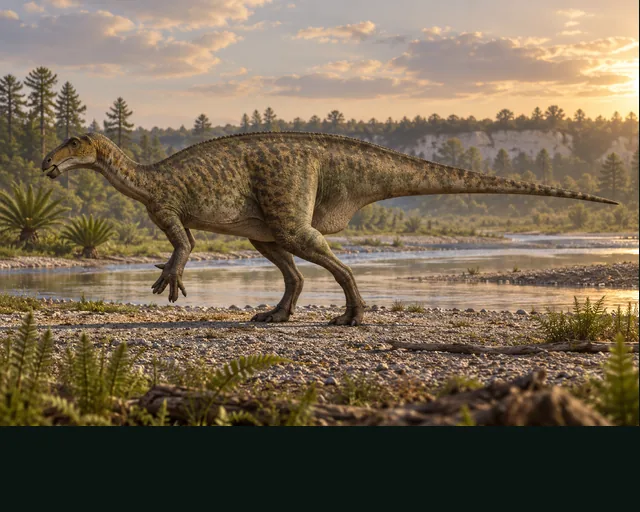
Nobu Tamura’s complete named Barilium dawsoni restoration supplies our whole-body reference. It depicts a deep bulky iguanodontian torso, a beaked head, shorter forelimbs, robust hind limbs and a long complete tail. Colours, dorsal surface detail and soft tissues remain artistic interpretations.
Our new scene follows that living artwork instead of building the missing body from partial bones or substituting Iguanodon. It does not provide a new mass estimate or establish a distinctive behaviour.
Read Iguanodon and Mantellisaurus for related but separately documented accounts, then browse the A–Z directory. A change in a label can reveal a more carefully understood fossil record.
Quick answers
- Was Barilium once called Iguanodon?
- The species was originally Iguanodon dawsoni; Norman placed it in Barilium in 2010.
- Is every Iguanodon now Barilium?
- No. The revision separates specific taxa and geological assemblages rather than renaming the whole genus.
- When did it live?
- In the Valanginian part of the Early Cretaceous, represented by the lower Wealden Group.
- Does a new genus mean a new fossil was found in 2010?
- Not necessarily. A taxonomic revision can reinterpret material already in collections.