Jurassic Dinos editorial · Updated · Source-based review
What was Hypnovenator?
Hypnovenator was a troodontid dinosaur from Early Cretaceous Japan. Its species Hypnovenator matsubaraetoheorum was described in 2024 from the Ohyamashimo Formation of the Sasayama Group, at Tambasasayama in Hyogo Prefecture.
The studied deposits belong to the Albian interval. They record a river-related setting, adding another environmental context to the growing record of small bird-like theropods preserved in curled postures.
What was preserved?
The specimen is an articulated postcranial skeleton. Postcranial means the body behind the skull, and articulated means that bones remained connected in their original sequence.
That arrangement allowed researchers to investigate both anatomy and posture. It does not provide a complete fossil head or preserve every feather in the portrait. The visible face and colour pattern must therefore remain part of the artistic reconstruction rather than new observations from the specimen.
Was the dinosaur asleep?
The original authors interpreted the curled arrangement as a sleeping posture. Similar comparisons involve how the neck, limbs and body are folded, together with an assessment of preservation.
A fossil still records the result of death and burial, not a direct observation of a living animal’s state. Resting and sleeping interpretations need to be distinguished from certainty about the final instant of life. The discovery also does not mean that troodontids slept only in one type of environment.
What did the hands and feet reveal?
The study compared the shapes and likely functions of hand claws and examined a mixture of foot characters associated with movement. These analyses address different questions from the interpretation of the curled body.
A claw’s curvature and proportions may help investigate how a hand functioned. They do not automatically identify a particular prey item or establish an exact running speed. Functional interpretations need to remain connected to the structures actually studied.
Where did it fit in the family tree?
The original analysis placed Hypnovenator near the early part of the troodontine branch. This helps test when some characteristic anatomical combinations were already present, while leaving the precise details open to further comparison.
Reading the portrait
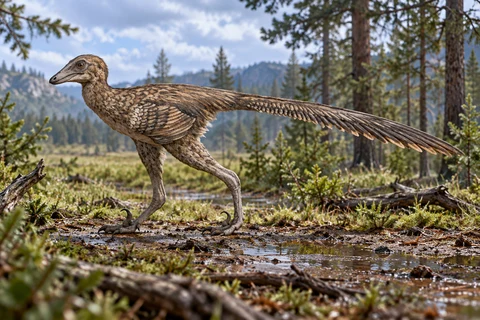
The approved complete reference guided the small low head, curved feathered neck, folded forelimbs, long hindlegs and very long tail. The portrait shows an alert animal rather than reproducing the fossil’s curled position.
Orange head plumage, body colours, feather extent and soft-tissue contours are artistic. They are not evidence of preserved pigment or powered flight.
Compare Mei and Daliansaurus, or explore the H directory.
Quick answers
- Where was Hypnovenator found?
- In Tambasasayama, Hyogo Prefecture, Japan.
- When did it live?
- In the Albian interval of the Early Cretaceous.
- Does its name prove it died asleep?
- The curled arrangement is interpreted as a sleeping or resting posture, not a direct observation of its final behaviour.
- Are its orange head feathers preserved?
- That pattern follows the artistic complete reference, not the described postcranial fossil.