Jurassic Dinos editorial · Updated · Source-based review
What was Hylaeosaurus?
Hylaeosaurus was an armoured plant-eating dinosaur from Early Cretaceous England. Gideon Mantell described its species Hylaeosaurus armatus in 1833 from the Sussex fossil record.
It is less familiar than Iguanodon or Megalosaurus, but shares a central place in dinosaur history with them. These three genera provided the basis for Richard Owen’s definition of Dinosauria, published in 1842.
Why did the three animals belong together?
Early researchers were working from incomplete fossils, long before today’s extensive dinosaur collections and evolutionary analyses. Recognizing shared anatomical characteristics allowed Owen to propose that the animals represented a distinctive group rather than simply enormous versions of familiar living reptiles.
That historical grouping was a starting point. Later discoveries transformed ideas about dinosaur diversity, posture, size and relationships. Being part of the original definition does not mean that every nineteenth-century reconstruction of these animals remains anatomically current.
What kind of armoured dinosaur was it?
Hylaeosaurus belongs to the ankylosaur story. These dinosaurs developed bony structures in the skin, often called osteoderms, but different taxa had different combinations of plates, spikes and other armour.
A complete arrangement is harder to establish when fossils preserve only part of the animal. An isolated spike has to be assigned a position, and missing regions must remain uncertain. It is therefore important to distinguish the presence of armour from a fully confirmed map of every plate over the back and tail.
Why keep historical images in the discussion?
Historical reconstructions show how researchers and artists interpreted the evidence available at a particular time. They are valuable records of changing ideas, provided they are labelled rather than presented as direct photographs of the past.
Comparing such artwork with the specimen record can teach readers to ask which details are observed, which are inferred and which were inherited from earlier artistic conventions. A polished new rendering does not remove those underlying uncertainties.
Reading our portrait
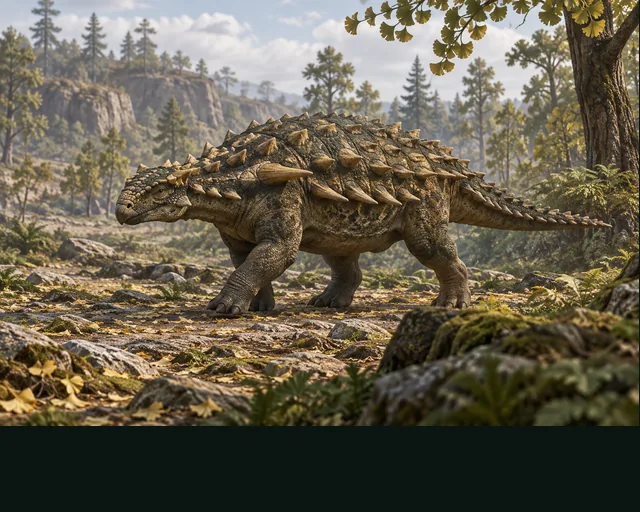
The approved complete reference used here has a historical-style banded armour layout. Our image retains its broad low body, lateral spikes, four-legged stance and tapering tail without a club.
The conspicuous bands, exact plate arrangement, rounded back, colours and skin texture are artistic interpretation. They should not be read as a claim that the entire arrangement was preserved with the type specimen. The picture introduces a historically important dinosaur while this caption makes the reference’s limits explicit.
Compare Polacanthus and Iguanodon, or explore the H directory.
Quick answers
- Who named Hylaeosaurus?
- Gideon Mantell described it in 1833.
- Why is it historically important?
- It was one of the three genera Richard Owen used when defining Dinosauria in 1842.
- Was it armoured?
- Yes. It belongs to the ankylosaur group of armoured plant eaters.
- Is the exact banded shell in the portrait confirmed?
- No. That complete layout follows a historical-style reconstruction and remains interpreted.