Jurassic Dinos editorial · Updated · Source-based review
What was Huehuecanauhtlus?
Huehuecanauhtlus was a plant-eating dinosaur from Late Cretaceous Mexico. The species Huehuecanauhtlus tiquichensis was described in 2012 from Santonian deposits in Michoacán, in the southwest of the country.
It belongs to the hadrosauroid part of the ornithopod story. The original analysis placed it close to, but outside, Hadrosauridae, the family containing many of the familiar duck-billed dinosaurs.
How was it identified?
The study used a combination of dental, backbone and limb-related characters. A particularly distinctive feature involved the shape of the ilium, a major bone of the pelvis.
Comparing several body regions helps researchers test whether a specimen represents a separate taxon. Some characters may be shared with relatives, while their combination is distinctive. A diagnosis is therefore more than finding one unusual-looking bone or noticing that an illustration has a different head shape.
Why distinguish hadrosauroids from hadrosaurids?
The broader hadrosauroid group includes close relatives outside the narrower family. Those animals can help researchers investigate the sequence of features associated with hadrosaurid origins.
An animal outside the family is not an unsuccessful attempt to become a later duckbill. It represents its own branch of evolution. A family tree is a model of shared ancestry, not a competition in which every earlier branch must disappear as soon as another evolves.
What does its location tell us?
A diagnostic specimen from Mexico adds a geographical point to the record of these relationships. The original study considered alternative explanations involving dispersal or an ancestor distributed across more than one land area.
Those alternatives should not become a single certain journey in a popular account. Researchers must compare fossil ages, anatomy and changing geography before choosing among them. A modern national border is also not a barrier that existed in the same form during the Cretaceous.
Reading our portrait
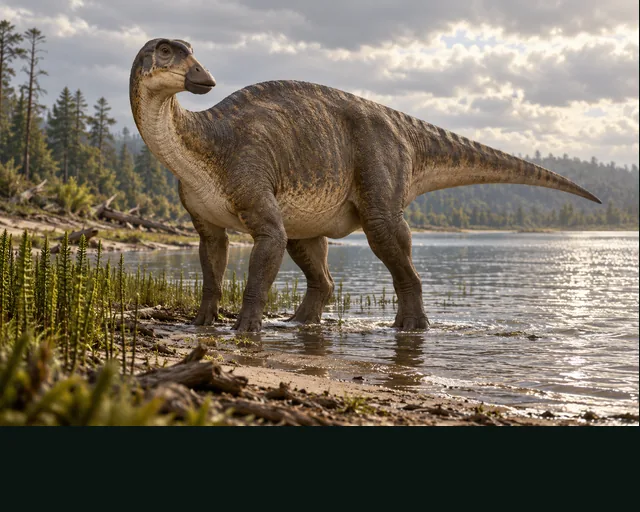
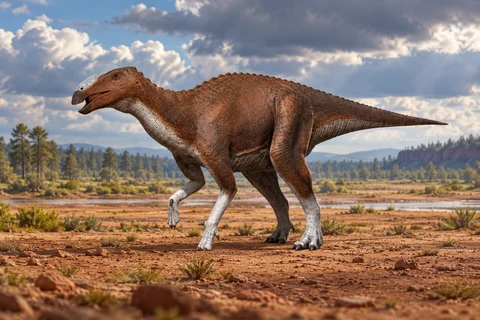
The approved complete Huehuecanauhtlus reference guided the broad beaked head, deep trunk, four limbs and long tail. Its raised dorsal outline and small scallops are parts of the artistic restoration, not a directly preserved skin silhouette.
The incomplete fossil record does not establish all the body’s proportions, colours or texture. The portrait shows a single animal with its head lifted; that pose does not prove a particular call, display or habitual stance. No precise adult mass or maximum length is derived from the artwork.
Compare Hadrosaurus and Eotrachodon, or browse the H directory.
Quick answers
- Where was Huehuecanauhtlus found?
- In Michoacán, southwestern Mexico.
- When did it live?
- Its studied deposits are Santonian, within the Late Cretaceous.
- Was it a hadrosaurid?
- The original analysis recovered it close to but outside that family.
- Does the name prove an exact migration?
- No. The study considered alternative explanations for its geographical occurrence.