Jurassic Dinos editorial · Updated · Source-based review
What was Eotrachodon?
Eotrachodon was a plant-eating duck-billed dinosaur from Alabama. Its species is Eotrachodon orientalis, described in 2016. The fossils come from the Mooreville Chalk record and belong to the latest Santonian part of the Late Cretaceous.
Its discovery contributes to the dinosaur history of Appalachia, the eastern North American land area separated from western Laramidia by a large seaway. The eastern record is less familiar than many western dinosaur sites, making well-documented specimens particularly useful.
Why was its skull important?
The anatomical study described both cranial and postcranial material. Cranial means the skull, while postcranial refers to the rest of the skeleton. Together they provided several regions that could be compared with other hadrosauroids.
The animal combined features associated with earlier-branching hadrosauroids and features shared with more derived hadrosaurids. Such a mosaic is not an evolutionary mistake. Different structures can change at different points in a lineage’s history.
Did it have a large crest?
The reviewed description identifies a slender, crestless nasal region. That helps distinguish it from another Alabama hadrosauroid, Lophorhothon, and prevents a familiar hollow-crested dinosaur silhouette from being applied automatically.
A broad beak is a useful visual starting point, but it does not make every duck-billed dinosaur identical. Detailed skull and tooth characters can distinguish animals with superficially similar body plans.
Was the animal still growing?
The researchers examined a section of the tibia, a lower-leg bone. Its microscopic structure suggested active growth at the time of death. That means the specimen should not simply be treated as a direct measurement of the species’ largest adult.
Growth evidence can improve an interpretation, but it is not a complete biography. The fossil does not reveal every meal, movement or social interaction experienced by that individual. Whole-animal estimates require assumptions that should be explained.
What does eastern geography add?
Comparing eastern and western fossils helps researchers test how the seaway influenced dinosaur communities. A discovery in Alabama does not, by itself, prove that every member of a large dinosaur group originated there. Broader conclusions require multiple records and relationship analyses.
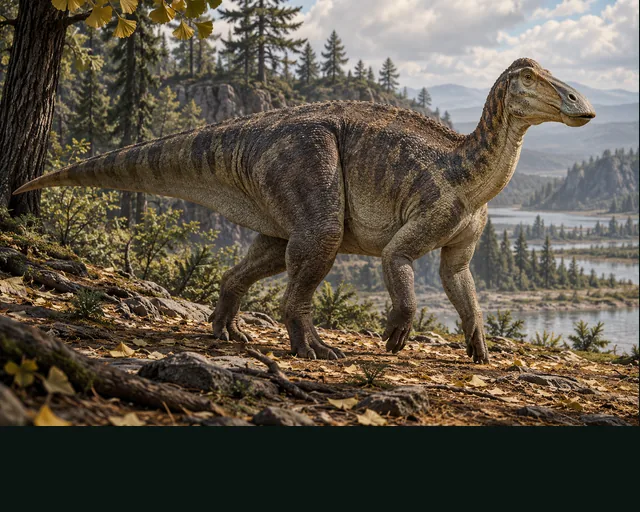
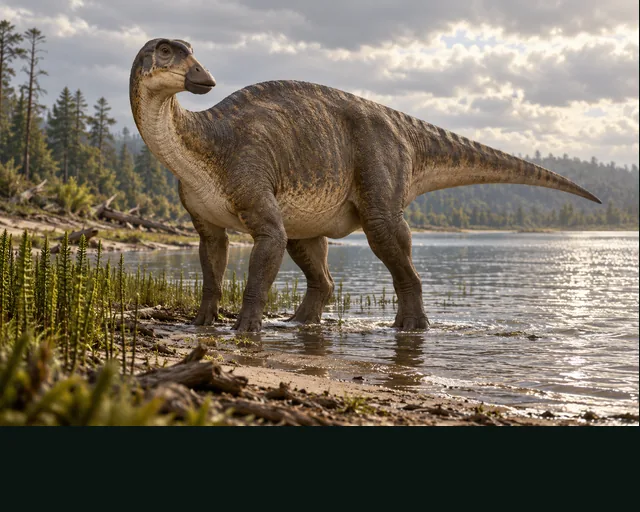
Our portrait follows a complete reference specifically identified as Eotrachodon. It retains the broad low head, deep body, four-legged stance and tapering tail. Colours, dorsal surface detail, thumb-region completion and soft tissues remain artistic interpretations. No enormous hollow crest is added. The picture offers a whole-animal introduction while the article explains the skull and growth evidence behind the name.
Compare Hadrosaurus and Edmontosaurus, then explore the E directory.
Quick answers
- Where was Eotrachodon found?
- In the Mooreville Chalk record of Alabama, in ancient eastern North America.
- What was Appalachia?
- The eastern North American land area separated from western Laramidia by a Cretaceous seaway.
- Did it have a giant hollow crest?
- The reviewed description identifies a slender crestless nasal rather than a large hollow head crest.
- Was the individual fully grown?
- Its tibial bone tissue suggested it was still growing when it died.