Jurassic Dinos editorial · Updated · Source-based review
What was Huashanosaurus?
Huashanosaurus was a plant-eating sauropod from Jurassic southern China. Its species Huashanosaurus qini is based on a partial skeleton from the Wangmen Formation near the Mingjiang River in Ningming County, Guangxi.
The animal belongs to the eusauropod part of the long-necked dinosaur story. It should not be confused with a newly named Cretaceous titanosaur simply because both animals are large, four-legged sauropods.
Which bones helped distinguish it?
The original diagnosis includes features of the ulna and fibula. The ulna is a forearm bone, while the fibula is one of the lower-leg bones. Their processes, cross-sectional shapes and surface grooves provided characters for comparison.
These are detailed anatomical observations rather than dramatic external ornaments. A hook-shaped process on a bone does not necessarily produce a visible hook on the outside of the animal. The fossil characters used for diagnosis should therefore remain separate from the surface details of the portrait.
Why is the age not given as one precise date?
The study discussed an Early to Middle Jurassic context for the Wangmen Formation. Earlier work had proposed an older Early Jurassic age, while the new dinosaur’s relationships encouraged a reconsideration of that interpretation.
An age inferred partly from evolutionary comparison is not identical to a direct numerical date from a suitable volcanic layer. This account retains the broad Jurassic period and explains the uncertainty rather than assigning an exact date to the specimen.
What did the family-tree analysis suggest?
The original analysis placed Huashanosaurus farther along the eusauropod branching sequence than Shunosaurus. That helps researchers investigate the diversity of Chinese sauropods and compare the anatomical combinations found in different regions.
It does not make Shunosaurus the direct ancestor of the new animal. A branching relationship describes a hypothesis of shared ancestry, and new material can change the details. Keeping that distinction clear avoids turning an evolutionary tree into a simple ladder from one named dinosaur to another.
Reading the reconstruction
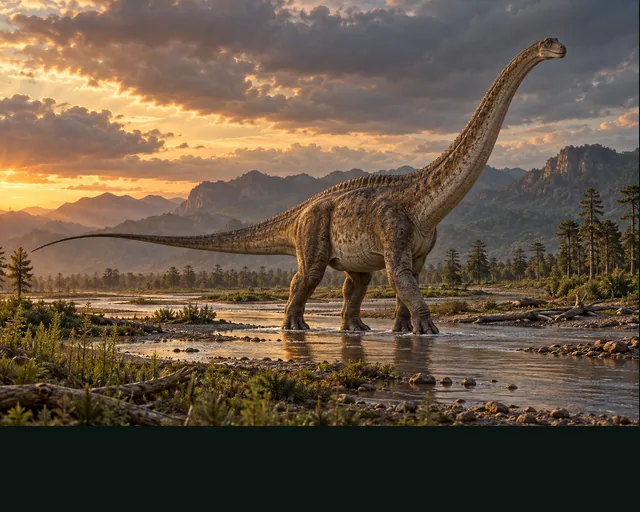
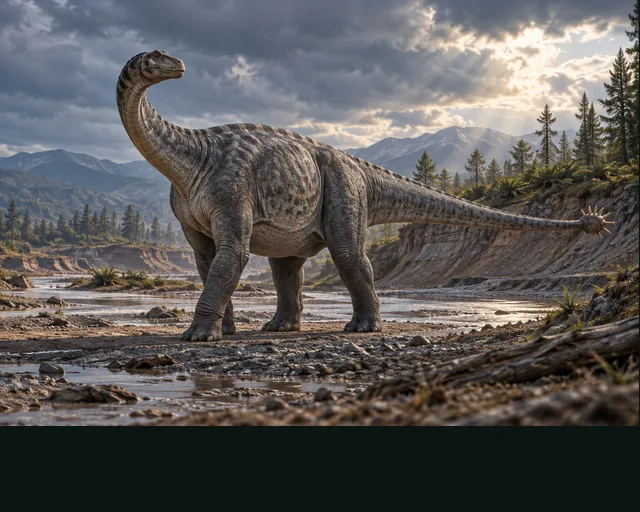
The approved complete Huashanosaurus reference guided the small head, rising neck, heavy torso, four supporting limbs and tapering tail. The low ridge and mottled body pattern follow that artwork.
Those external details, exact proportions and colours remain artistic. They are not additional discoveries from the partial skeleton. The portrait provides a visual introduction without claiming a measured adult mass or a complete preserved skin pattern.
Compare Shunosaurus and Omeisaurus, or browse the H directory.
Quick answers
- Where was Huashanosaurus found?
- Near the Mingjiang River in Ningming County, Guangxi, southern China.
- Is it a giant Cretaceous titanosaur?
- No. The reviewed study concerns a Jurassic eusauropod.
- What made the specimen distinctive?
- The original diagnosis includes unusual features of the ulna and fibula.
- Why is its epoch left broad?
- The study discusses uncertainty between Early and Middle Jurassic age interpretations.