Jurassic Dinos editorial · Updated · Source-based review
What was Huanansaurus?
Huanansaurus was an oviraptorid theropod from the Late Cretaceous of southern China. Its species Huanansaurus ganzhouensis was named in 2015 from the Nanxiong Formation record of Ganzhou, Jiangxi.
The original description emphasized a combination of skull features and proposed a close relationship with the Mongolian Citipati. Subsequent work has added a new question: whether another named Ganzhou oviraptorid represents the same species.
What did the 2026 study propose?
Mingze Hao and Xing Xu described a new nest-associated specimen and re-examined the anatomy of Huanansaurus and Corythoraptor jacobsi. Their analysis proposed that these names and the new specimen were best regarded as representing one species.
That is a taxonomic interpretation based on comparisons, not the discovery of a second identical animal. This cohort therefore provides one Huanansaurus account and does not add a separate Corythoraptor page for the same proposed species.
Why can similar fossils receive different names?
Initially described specimens may preserve different regions, growth stages or degrees of distortion. Features that appear distinctive in one comparison can become less convincing when additional material bridges the apparent gap.
The opposite can happen as well: more detailed study may reveal that one familiar name hides several taxa. The important step is to return to the actual anatomy and test the alternatives, rather than assuming that every published name must remain a separate animal forever.
What does a nest-associated skeleton reveal?
The newer specimen adds information about oviraptorid posture over a nest. That association can be investigated directly, while broader claims about incubation, parental roles and the behaviour of every member of a species need additional evidence.
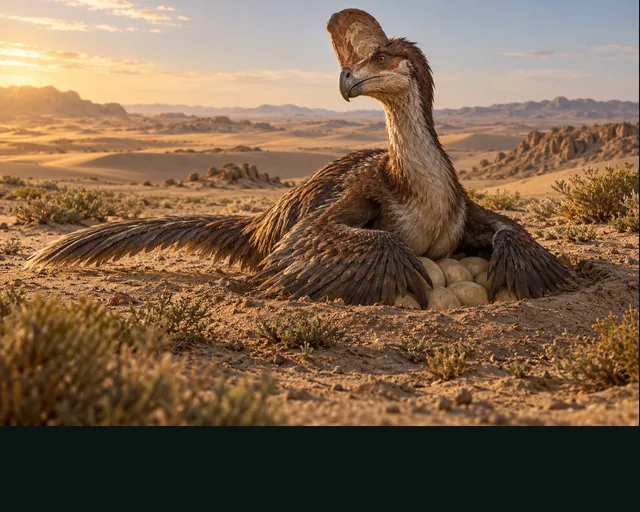
A body position is not a complete behavioural diary. Researchers consider preservation and anatomy before interpreting what the animal was doing. The image on this page does not reproduce the nest scene or invent the sex of a caring parent.
Reading our reconstruction
The approved complete Huanansaurus reference guided the short beaked head, long neck, feathered torso and forelimbs, long hindlegs and narrow tail. Its head contour remains modest; a spectacular casque from a different picture has not been added.
The extent of the feathers, colours and soft-tissue contours are artistic. The portrait introduces the animal while the text records the newer synonym proposal and keeps it separate from claims of universal agreement. A changing name map is part of scientific research, and the source dates help readers follow that change.
Compare Citipati and Oviraptor, then explore the H directory.
Quick answers
- Where did Huanansaurus live?
- In the Late Cretaceous Ganzhou region of southern China.
- What is the newer naming proposal?
- A 2026 study proposed that Huanansaurus and Corythoraptor represent one species.
- Does that add two animals to this catalogue?
- No. This cohort uses one Huanansaurus account and does not add a separate Corythoraptor page.
- Is every nest-associated feature certain?
- The specimen and posture interpretation must be distinguished from wider claims about all individuals.