Jurassic Dinos editorial · Updated · Source-based review
What was Heyuannia?
Heyuannia was an oviraptorid theropod from Late Cretaceous Asia. This account focuses on the Chinese species Heyuannia huangi, which has become particularly interesting through research on associated eggs.
Oviraptorids are often illustrated with beaks, feathers and unusual head contours. A life portrait can introduce those animals, but scientific evidence for colour needs more than an artist choosing an attractive palette.
How were eggs connected with the dinosaur?
A 2017 study investigated eggshell assigned to the egg category Macroolithus yaotunensis. The authors linked that egg type with Heyuannia huangi through well-preserved embryos at a late developmental stage.
Egg categories and adult dinosaur names describe different parts of the fossil record. Connecting them requires evidence such as embryos, rather than simply finding eggs somewhere in a region where a dinosaur also lived. The association is the basis for discussing the eggs in this account.
What did the chemical analysis find?
The researchers detected biliverdin and protoporphyrin, pigments also involved in the colours of bird eggs. Their analysis supported a reconstruction of visibly blue-green eggshell.
They compared the fossil samples with standards and examined surrounding sediment as a control. Such checks help test whether a detected substance belongs to the shell rather than representing contamination. This is a different method from looking at the present dark colour of a fossil and assuming that it matches the egg in life.
Does that tell us the colour of the adult?
No. A pigment result from eggshell does not establish the colour of feathers, skin or a head crest. Each tissue and specimen needs its own evidence. A dinosaur with coloured eggs need not have a matching body pattern.
The study also discussed nesting implications, but a colour result alone cannot identify which parent watched a particular nest. Behavioural explanations should remain distinct from the chemical observation that supports them.
Reading our reconstruction
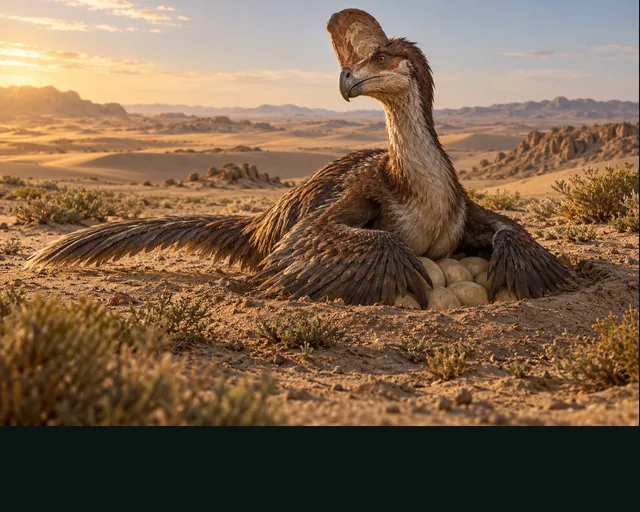
The approved complete Heyuannia reference guided the beaked head, long feathered neck, clawed forelimbs, long hindlegs and upturned tail fan. The crest contour and full feather arrangement contain artistic interpretation.
Our brown-and-cream plumage is an artistic choice, not a transfer of the eggshell pigment result onto the adult’s body. The image also does not establish powered flight or a specific diet. These distinctions allow a colourful reconstruction to accompany a clear explanation of what the research actually measured.
Compare Oviraptor and Citipati, then explore the H directory.
Quick answers
- What kind of dinosaur was Heyuannia?
- An oviraptorid theropod from the Late Cretaceous of Asia; this account focuses on the Chinese species H. huangi.
- What colour evidence exists?
- A study of associated eggshell detected pigments supporting blue-green egg colour.
- Does that reveal the adult feathers?
- No. Eggshell colour and adult plumage are different kinds of evidence.
- Does egg colour prove which parent cared for a nest?
- Not by itself. A behavioural explanation requires further evidence.